Connecticut Custom Airguns
  • Welcome!
  • Hector's Airgun Blog
  • Products and Products Blog
    • One-Off's
    • The "Héctors Special'" scope by Sightron
    • K1050i FT
    • The Hex Louver or "Secret Sunshade"
    • Pellet Path Calculator >
      • Questions, Answers and Comments on P-P Calc
      • Privacy Policy for PP-Calc
    • The Nautilus SideWheel
    • The X-10 TiltMeter
  • Zimmer-Silhouetten
    • Results 2017-2018
    • Results 2016-2017
    • Results 2015-2016
    • Results 2014-2015
    • Results 2013-2014
  • References and Links
  • Contact us
  • Store

Hector's Airgun Blog

Where we discuss, CIVIILY,  anything airgun.

Return Home

The 2026 MD State FT Championship

5/13/2026

2 Comments

 
This year, 2026, marked the 30th Anniversary of the DIFTA (Damascus Izaak Waltton League, Field Target Assocaition) range in operation.
To my knowledge, the oldest FT range in Continious Operation in the US, having started operations in 1996.

Back then the course was simpler, and the shooters were few, here are two pictures from the following year, taken from an old document. I apologize for the quality of the image:
Picture
Anybody that has been to DIFTA will recognize the "main path"
And here is another that anyone would recognize:
Picture
A trusty HW or perhaps a FWB of the times with a scope, probably a Bushnell Elite AO.

Far from today's equipment, still, we need to reflect on the vision and the accomplishments of the founders, among which were persons that are regarded, today, as foundational personalities in the US airgun scene, like Tom Gaylord, and Jim Maccari

So, 30 years down the road, here we are and we gathered at the DIFTA course for the 2026 MD State Match.
All in all, there were 14 shooters, distributed across Hunter (PCP and Piston), Open (PCP Only) and WFTF (PCP only).
Weather was very agreeable, but challenging due to the shifty winds and sudden calms.
Scores were not high, no information has been released about the layout, so if I had to estimate a TDR for the course, it would be in the 28->30 but it is just an estimation.

I was lucky enough to share the lanes with my friend Toby M. He shot well, me . . . not so much.
The challenges encountered at Atglen surfaced with a vengeance in a more difficult and challenging course.
Match High was a 46/60 (Hunter PCP), and that tells you a lot about the wind conditions.Top WFTF shooter shot a 34 and top Open shot a 39.
DIFTA has the bad habit of assimilating along Divisions, which makes little sense.
There is MUCH more in common between Hunter Piston and WFTF Piston, than between Hunter PCP and Hunter Piston.
Hopefully, the BoG's at AAFTA will soon give more guidance on this.

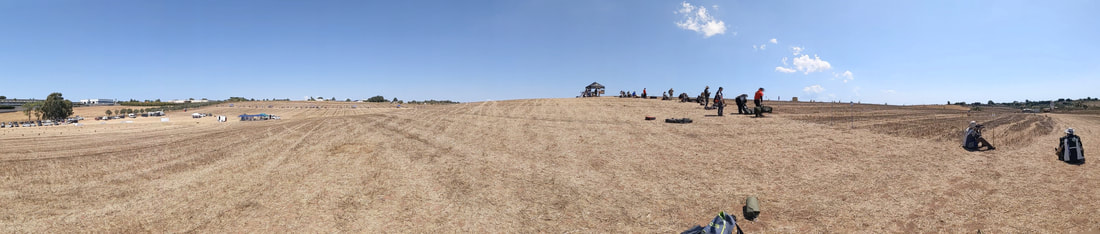
How did the lanes look?

We started on lane 11, the longer lane in a depresion; so, let's look at them: in the order they were shot.

General view and then detailed view, as always:
Picture
Picture
Lane 12: 
Picture
Picture
As you can see, Lane 11 is in a depression of the terrain, and lane 12 is on the "left uphil side" of that depression.
The picture also shows that, to the left of the lane, the land opens into pasture/field, allowing the full force of the wind to be felt.
At a certain speeds, the wind not only blows sideways, it start "rolling" over the ridge, with some very peculiar effects on the pellets.
I had my reservations about the near "gopher", so I made a mental note to check on it later.
​​
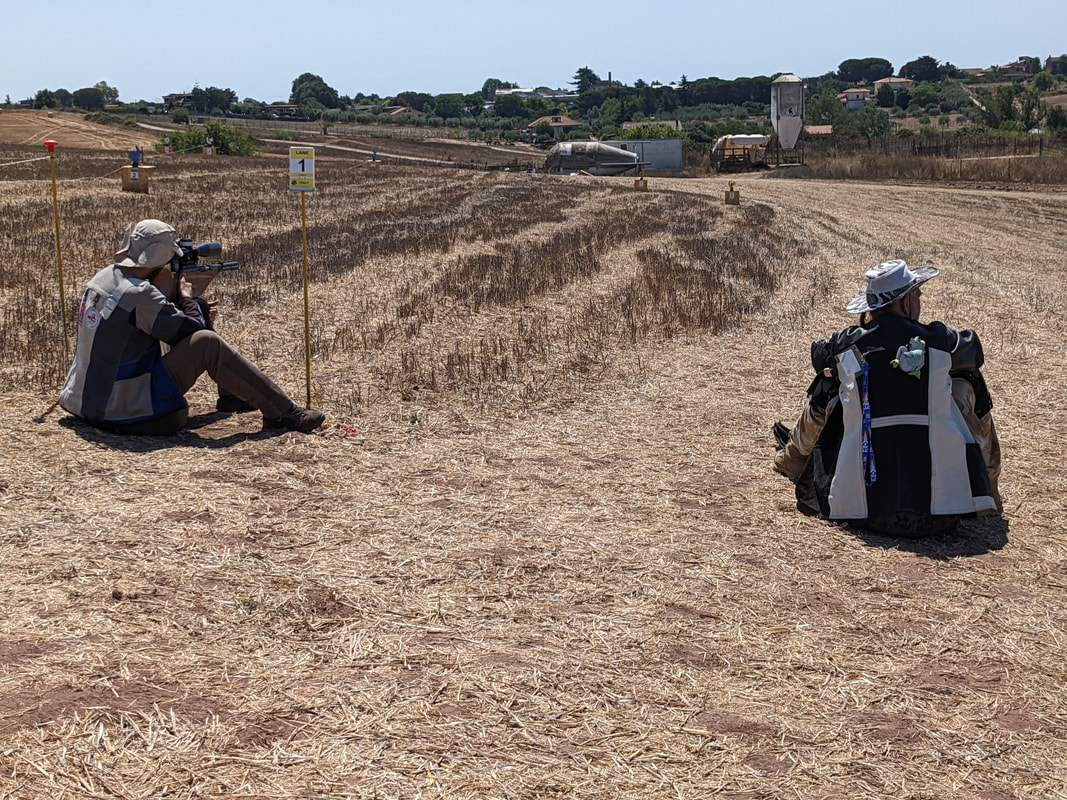
From there, it's an uphill hike to lane #1:
Picture
Picture
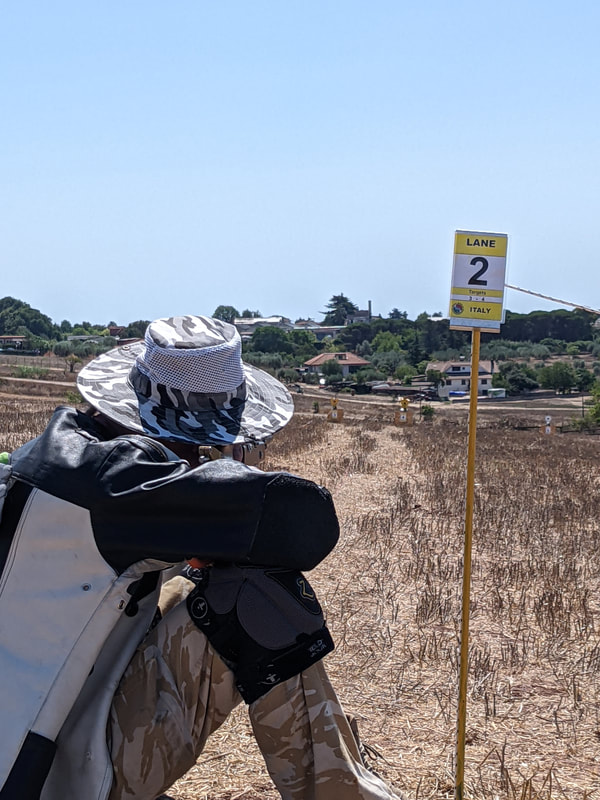
The second lane of the Match was Lane 3:
Picture
Picture
Lane 4:
Picture
Picture
Lane 5 was the Standing lane:
Picture
Picture
Lane 6:
Picture
Picture
 That little Blue bird in the "Near" position posed a peculiar problem, but more on that later.

Lane 7, with Long Tom at the middle position:
Picture
Picture
Lane 8:
Picture
Picture
There was no Lane 9, here is Lane 10, that was the Kneeling lane:
Picture
Picture
A good Match, with some reserves, but a good match overall. 

Somoeone asked in a forum about a picture of the REAR of Long Tom, to replicate the "Heart Attack" target, so here it is:
Picture
You can see that there is a LONG paddle that falls on a little "arm", that then pulls the target down.
Target has a stop because otherwise it would not reset well, and the paddle is itself thereset lever, being pulled by the reset string through the faceplate itself.
It's the long distance between the paddle and the little arm what creates the time lag. Just enough to give you a "Heart Attack" thinking you have missed.
​Here is another view:
Picture
It's a tough target, and it "hides" behind a tree.
Challenging indeed. I've gotten it down a few times, but it wasn't to be this time. Missed it twice.

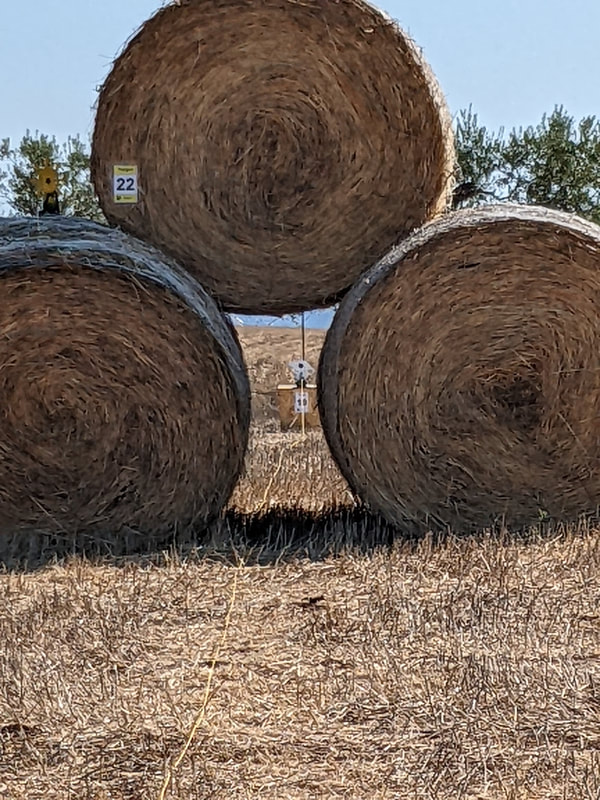
Now, why was I so bothered by the "near Gopher" in lane 12?

​This is why:
Picture
A typical, and typically ignored problem, of small KZ's (3/8"s): the concentration of lead after a bunch of people have shot 20 ft-lbs pellets into the same spot. This level of accretion does not correspond to one match, this is a buildup over several.
​
Here is another look:
Picture
Picture
Yup!
There is a "buildup" of lead on BOTH sides of the paddle
This connects the paddle to the faceplate in ways that prevent the paddle from falling with less than 20 ft-lbs directly on the paddle.
The slightest contact with the rim of the KZ, and the target refuses to fall.

The other target that called my attention was that little Blue Bird on lane 6, and here is why:
Picture
In the dappled light of the forest, when the sun hits the KZ, there are reflections from the bare steel dents that create a "difuse" sight picture, to the point where I could not make out the exact rim of the KZ.
I do not know what is the material that this faceplate is made out of, but clearly it is soft enough that lead pellets create some serious dents and deform the KZ to the point where it is no longer truly "round".

As per AAFTA 2026 Handbook, page 6, Section: "Targets", Subsection: "B", and I quote:

"B. Hit-zones shall be round and shall range from 3/8" to 2" in diameter. No fake hit-zones may appear anywhere on the target."

This target should not have been set in the course.

For whatever it's worth I offered help to repair/maintain these targets a week ago, with no answer, yet.

Bottom line for me was that a new rig/system was in order, too much of a handicap shooting the Mauser with the old AEON.

A quick review of the "Hunter Division" rules told me that I could use my LGU with the "Varmint" stock even WITH the hamster attached, so that is what I will use.

FT is a never-ending process of learning, and re-learning; searching and finding; and that is one of the aspects that makes it so fascinating.
The other aspect, is the people that shoot FT.

Keep well and shoot straight!


HM
2 Comments

FT at Atglen, PA

5/12/2026

0 Comments

 
Back in May 2024, I ws invited to a "new to me" Club, about 2 hrs drive from my "local neck of the woods"

A BIG surprise awaited me. A relatively short drive on the highway and, from there, smaller, winding road across true Amish Country, horse-buggies and covered bridges:
Picture
I simply fell in love with the place!
The tranquility of the flowing creek, the approach to the Club, the layout of the sighting in range, and then . . .  the lanes!
What lanes! Variety and challenge made for a VERY interesting course.

Since then we've been to a few matches, somewhat intermittent, through no fault of anyone, simply life events that get in the way.
Towards the end of last year and with the participation of more members, the Club's FT activities have really taken off.

New lanes have needed to be cut because some forestry operations will take place, and to really care for a forest, you need to steward it. So some heavy machinery will have to come and take out those trees that are too old/non-productive and allow space and light for new trees to really spread out.
Of course there are plans to later use that "road" as part of the FT area  ;-)

AND, to clarify, IMHO:
This is the difference between stewardship and outright conservation.
Conservation to the extreme is perfect, when you have thousands of acres and unmolested nature.
When you have a "smaller" (still hundreds of acres) area, where the wildlife has changed, humans are nearby, and it is not precisely and wholy "wild", there's a need for stewardship.
So, Kudos! to Atglen S. A. that is taking the steps to protect the long term health of their forests by careful and precise forestry measures.

And this brings us to the current shoot, held at Atglen on April of 2026

​It all started at the sighting in range:
Picture
I don't think anyone of us was shooting broadheads, LOL!
Actually we, the airgunners, share the archery range (as is the case in MANY clubs) for sighting in.
You can see, at the top right hand of the picture, where the new lanes have been cut.
And I have to say that there was a "Theme" to the shoot. Let's call it "Through the two Trees", LOL! (not my idea, my idea was a bit rougher around the edges). But we'll come to that.
I had the pleasure and the privilege to shoot with my good friend Mike Harris
Picture
Mike is one of the Pillars of FT in the Northeast, Mike used to run the two ranges at Delaware County Field and Stream until health issues prevented him from continuing to do so. Now on the mend, he still finds the energy and the time to shoot.
Congrats and thanks, Mike for all that you did AND do, for FT!
AND, BTW, the man in charge now is Mark King, who is also doing a fantastic job at keeping the shoots alive. But, . . . that deserves its own story.
​Back to the shoot, it was well attended (12 shooters) considering the weather forecast (nothing too enticing, but still, we were there!).
Picture
The way Trevor designed and executed the course was interesting.
WE were out in the open; for the particular day, it was not a challenge, even with semi-good scopes (I was shooting a MAUSER K-98s with an old AEON scope). The overcast day afforded us a mildly lit area to shoot from into the woods.
Let's wait a few months and we will see how challenging that course becomes in summer, when we are shooting from a brightly lit / sunshined area into the densely packed forest with a full canopy of leaves.
Start preparing to shoot with lower magnifications, LOL!
Here are some typical lanes:
Picture
Picture taken at 20X, it transmits the message: Follow your strings, or you will be shooting the wrong target.
​;-)
But how does a typical lane look from the shooting gate?
​Like this:
Picture
Remember "The Theme"?
​Can you see the targets?
¿no?
Follow the strings!
Picture
First string from the left goes around the tree and gets to the first target, right "between . . .  the TWO TREES!"
For those that like "lifelike" targets, I am sure you are almost salivating over this one.
Thanks to Laura S and Rich B for the paint/decoration.
I have to admit that they are attractive, even if it pains a little to shoot at them. ;-)

Want to see another target?
​Here is one for you:
Picture
Yes, it is between  . . . . TWO TREES!
And another?
Picture
Yes, there were also a bunch of targets more "open to view", LOL!
​One thing that is peculiar to Atglen is this:
Picture
Yup!
There is a Prone lane, designated by the MD as a "forced position" lane.
As per the rules, you can shoot this lane in any other approved "forced position" so, you can shoot it, in order of difficulty:  Kneeling, or Standing.
HOWEVER, you CANNOT shoot it sitting.
Why? because sitting is the FT 'Free Position'.
:-)
It was fun and I enjoyed it immensely.
Missed my sling, that Mauser is one heavy gun. Still it was fun!
Now, just to clarify: Do take a good look at my position:
The hand that supports the rifle is NOT supported by the ground, if I had been wearing a glove, it would be the same. The ONLY object that can support the forward hand in a forced position is THE SLING.

Two point sling for Hunters, One pont sling allowable for Open and WFTF.

This is per AAFTA rules (2026 Handbook, page 6, section "Shooting", paragraph B) and I quote:

" Other than using aids permitted by specific AAFTA Division Rules (slings, bipods, etc.), the gun must be supported solely by the shooter's hands and body. The gun may not contact the ground. Any part of the body directly supporting the gun may not rest on the ground. The body may not lean on or be supported by any features other than the ground or the shooting seat".

Didn't do too well, I am "new to the Hunter Class" and still troubled by some shortcomings of the system, mainly the scope. The optics range beautifully, but the mechanics are not consistent enough.
And putting another scope is out of the question because the gun is so heavy in and of itself.
It shoots real well, the Mauser is incredibly stable at longer ranges. The whole architecture, allows for an extremely rigid barrel/action interfase. But it weighs a bit much.
We'll see.

BIG thanks to the Atglen Sportsman's Association, to Trevor D, Ed P, and all others that helped and attended.

After the shoot, we all adjourned to the "Brass Eagle" and shared a great dinner.
Picture
If you have the chance, make it a point to go to one of Atglen's shoots.
You will not regret the trip.

Keep well and shoot straight!


HM
0 Comments

The DoAll "Dialed Spinner"

4/24/2026

2 Comments

 
Disclosure:

The first "Dialed Spinner from DoAll was purchased from an online store.
The second version was sent under warranty by DoAll.
A bit of History:
​Back in the year 2K, while I was barely starting to scratch the surface of this enormous "rabbit hole" of airguns, I came across an idea that was good, but clearly needed some strong re-development.
Picture
Yup! 
Crosman used to sell a target comprised of 5 "sectors" that swung independently:
One central "bullseye" and 4 quadrants of a circle divided at 3, 6 and 9 O'Clock.
It was OK, except for two factors:
1.- It had been discontinued for years
​2.- It was rated for their CO2 rifles and pistols (so, about a 13-14 ft-lbs max.)

When a year later I saw one at the Little Rock Airgun Show (AR), priced @ $50 (of year 2k $'s), I decided it was time to act.

And so, the "Quadrant Spinner" came to life:
Picture
A first production batch was made in Argentina and was thoroughly tested. Back then 20 ft-lbs were more than enough. These spinners were designed to be reactive enough at 12 ft-lbs, and "pellet proof" at 20 because we followed AAFTA's power limits and springers at 10,000 FASL were not particularly powerful. PCP's were JUST coming down in price enough to be contemplated.
This was the year 2002.

Fast forward 7 years and when I started moving to the US, I had to leave my beloved set of spinners behind.

Once established, I set about finding a company that would make the spinners because no one offered the concept.
And I found a company in upstate NY that would build them.
Sent pictures and drawings and even went up there (I was living in CT back then) to see the first prototype.

We agreed on the prototype, and the first small batch was made. That was in 2012.
When they arrived, my heart sunk. The maker had added a horizontal cross member above the upper quadrants "to make it more robust". Fine, but that prevented the spinner from spinning! ¿huh?
He also took the liberty to add a couple of gauges to the material, and make them "extra strong"; based on his experience with shooting, it was needed (I also think it was the material he had at hand). The increase in gauge also created another problem: the counterweights were now not enough to ensure a true "return to vertical" from a low power hit in any of the lower quadrants.
In any case, they were not as reactive as they should have been at lower powers, and the result of a good hit was a bit "underwhelming" when the bullseye didn't circle around even once (due to the "hard stop" added).

They DID their job; and that was to allow people to "sight in" without needing to constantly change paper targets, without making a mess of used paper, and allowing fine tuning of FT skills because the "bullseye" followed WFTF recommendations: ½", ¾", 1" and 1½"
A few friends still have those.

Our design then was copied by a few companies.
Yes, people are like that. Without any improvement, redesign, or even name change, some outlets started marketing them.

Issue with those crudely made ones (to comply to a low cost barrier), was that 0.177" pellets could get in BETWEEN paddles and not indicate any hit.
Of course, by then the user had used the target and there were no refunds.
​
"Caveat Emptor" and all that.

But I always kept a soft spot in my heart for the concept. I tried to resurrect the production to no avail (cost was prohibitive), and the idea went dormant.

One day, looking at other things (as usually happens), I came across DoAll's version of the old Crosman 444:
Picture
I started using it with good success at Palmyra, when we started shooting LR FT. 
And it held well for airguns in the 50-60 ft-lbs range.
So, on an outing to check out some very accurate 22 RF rifles (a DIANA 22R bolt action, and an SPA Toggle Bolt), I took it along.

Hmmmm, the target had reached and exceeded its limits:  
Picture
Even at 100 yards, these rifles can keep their impacts very close together, if not in the same spot, and that created a problem, especially when hitting a bit "high" on the bullseye.
Things look even more dramatic from the rear:
Picture
Even packing the target becomes a problem when it cannot lay "flat":
Picture
Now, we did manage to "pound it into submission" with a good "dead-blow" mallet and some paint:
Picture
But clearly, the targets could not be sold as "rated for RF's" without creating some sort of customer dissatisfaction.
And, it was in this spirit that I wrote to DoAll.
I stated that the targets worked marvelously well with airguns up to 50-60 ft-lbs, and that they COULD be rated for 0.22" RF Short, but not for LR, even Standard Velocity.

I had to admit that I wasn't expecting a personal answer from a large company, like DoAll but, surprise, surprise!

I received an answer in 2 days and the kind person that answered showed me their "improved" version:
Picture
I asked what gauge material they were using and he responded, candidly, that he didn't have that datum, but that he would send me one to test.
WOW!
Clearly someone interested and, knowledgeable of the MARKET, if not of the product itself, of the MARKET (and that is really his job as customer relations). He understood he was talking to a person that was willing to go the extra mile.
I promptly furnished my postal address and waited. Not much, the target arrived, just in time for the first snowfall..... grrrrrrrrrrr.

Over the winter there was no opportunity to test it at the appropriate range (100 yards), and THIS PAST winter in Maryland was peculiar: Early snowfalls, then a sort of very short "indian summer", then more snowfalls separated by a few days in such a way that the range was closed for most of the season.

Range started opening in earnest a few weeks ago.

So, taking advantage of a sunny and not quite calm day, but with tolerable wind, I headed out to the range and tested.
Using  Aguila 40 grs, standard velocity ammo (about 1,080 fps) in both the "Competición" and the "Super Extra" grades in my two favourite RF's (an old Voere bolt action, and the SPA Toggle action), this was the result:
Picture
There are 30 shots in that target, see if you can count them.

Several hits were aimed at corners and edges and results were good.
​Important part is that repeated hits at three different points in the vertical support of the "bullseye" created NO distortion.
There are 6 hits in that vertical portion, three pairs, exactly ¼ mildot (milDOT, not mRad) apart.
Reason for that is I wanted to see if the inertia of the heavy bullseye was enough to act as a "hold" on the rotating part, therefore creating a "bend", therefrom the three chosen places tested for a "mid-weight" hit, a ¼ skewed weight hit and an extreme top hit.
None of them had any effect.
The vertical element is as straight as ever:
Picture
AND, BTW, that steel is a full 6 mm's thick, just shy of ¼" thickness.
The twists and bends do act as reinforcing points in an effective manner.
Picture
Does this version of the target reacts as well as the older one for airguns?
A bit. It does flip completely over at 50 ft-lbs and 100 yards, but not as "energetically" as the older one.

I will keep both because they BOTH have a role to play in my shooting, if you come across some of the older versions, and you are interested more in airguns of 60 ft-lbs and under, do get it, it is a lot of fun and very useful.
If you are more into RF's or airguns in the 70-150 ft-lbs, do look for the new version.
Retailers are not making much of the difference, so it is up to the customer to ensure they are getting the "Ver 2.0". THE thing to look for are the twists and bends in the vertical supports and that the only welds  are the spacer tubes between vertical hangers in the targtet. There are no other welds.

This target allows you to sight in and practice all at the same time.

Thanks to DoAll for their customer support and for putting on the market a product that does a needed job well.

​Now, if they made a set of four.............LOL!

Keep well and shoot straight!


​HM
2 Comments

It seems that the "Efficiency" thing might become a "Hot Button".- A proposal on how to measure it

2/25/2026

6 Comments


Joint Blog entry between Don Hansell and Hector Medina

First of all, thanks to Don for having a very slow "sticktion" and getting things done in a jiffy!
​;-)
So, let's start at the beginning:

WHAT is efficiency?

The dictionary has one definition that helps us:
" - the ratio of the work done or energy developed by a machine, engine, etc., to the energy supplied to it, usually expressed as a percentage."

Well, we will not use a percentage because in this context, we are dealing with different "forms" of energy.
I would propose to follow engineering criteria and express the efficiency of a PCP airgun as the ratio of the CC-BAR's needed to generate ONE ft-lb at the muzzle.

Before we continue with the discussion, it is important to clearly explain WHY we can compare a combined "unit" (CC-BAR)  to another (ft-lb).

Well, we'll start by observing they are BOTH ways to measure ENERGY, and "energy" and "work" are identical concepts. Physics 101 tells us that "Work" is the "change in energy" of an object.
In a pellet, the energy at the muzzle is the work that the gun has exerted on it. IF the pellet was already travelling, we would have to subtract the initial energy from the muzzle energy, but since the pellet is stationary, the change is exactly the muzzle energy.
Now, WHY can we use the Ft-lbs as a measure of energy?
Think about lifting an object (by pleasure or not): If you lift a mass of 1# over 12" , you have just exerted 1 ft-lb of work. If you release that object at the time of hitting the ground, the object will transmit to the ground 1 ft-lb of kinetic energy.

An example from our world: We tend to think of 12 ft-lbs airguns as "Nerf" guns, that's for the Brits. We like guns with multiples of that energy, what on Earth could you possibly do with "just 12 ft-lbs"?
Well, consider this:
You go bowling, and the bowling balls at your lanes are all 12#. The channel where the balls come out is a bit low, for aesthetic purposes, and the channel is located at 12" above the floor.
Your girlfriend has never been bowling, and she does not really know how to take the ball, you approach her when you see that she is using just two fingers. She cannot really lift the ball and the ball is perched at the edge of the rail.
When you get to her, he turns around to face you and the ball drops on your small toe.

You have just been hit by 12 ft-lbs., and I doubt you have the same concept about what "Just 12 ft-lbs" is.

;-)

So, we have established that Ft-lbs IS a unit that measures ENERGY.

But, what about CC-BAR? How could that be an energy unit?

Well, C-C stands for Cubic Centimeters, that means cm³, and it is = cm x cm x cm (length x width x breadth).
And BAR is a pressure, so it is a FORCE applied over an AREA, in unit terms, we can say that 1 kg of mass, resting on a square that is 1 cm per side = approx 1 BAR (0.98 to be precise).
And so, if we Multiply cm³ X kg/cm², we get kg-cm, which is a unit of energy/work because it is force exerted over a distance; exactly the same way that ft-lb is. Remember that in multplication, the order of the elements does not affect the result, so kg-cm is the same as cm-kg, or, within the different systems ft-lb.

Just a note here: ft-lb IS DIFFERENT from lb-ft, the former is a unit of energy, the latter is a unit of TORQUE.

We have now achieved the understanding that we are measuring a PROPORTION of energies:
The energy that goes out of the air tank/tube/bottle and the energy that comes out as a speeding pellet.

In THIS context, our "efficiency" measure is perfectly reasonable. AND since we are observing HOW MANY cc-bar's are needed to create ONE ft-lb at the muzzle, it makes for easy comparison across platforms.

Obviously, the LESS cc-bar's are used per ft-lb, the higher the efficiency of any given system is.
Remember: a LOW value is GOOD in this context.

Some writers want to go the "strict physics" way and divide the total energy output by the pressure excursion, but that does not take into account the volume of the chamber (tube/tank/bottle), so it is only useful as a comparison for THAT specific situation, and changes under this method can be tricky to interpret.

OK, so now, armed with our knowledge, let's take some examples from the real world.

My good friend Stephen Archer has just published an article on the tuning of the Micro-Strike, I do encourage you to read it in full. Since we cannot insert here any of the txts, figures, or charts, I will quote the numbers on two interesting tests that are summarized in this table:
Picture
As you can see, the efficiency of the system is pretty consistent whether the starting pressure is 300 BAR, or 207 BAR.
The difference between 33.9 and 34.0 can easily be explained by the rounding of some numbers.
These "settings" (hammer force strike and regulator pressure) then need around 34 cc-Bar/ft-lb

Along some discussions, some friends have pointed out that it is not too "scientific" to mix unit systems, and I agree, but (always a big but somewhere), if we were to unify the systems to either all metric, or all SAE, we would be doing a dis-service to the users.
¿Why? because current literature available already uses a MIXED system of units.

If you go to the Pyramyd AIR page ​corresponding to the Micro Strike, you see this:
Picture
Sorry for the size, but if you want to consult the source page, its here

In any case, you can clearly see that the MOST COMMON data available for tank capacity is CC's and the most commonly available data for air pressure is in BAR

On top of that, I want to make it clear to everyone that we are not measuring the TRUE efficiency of our airguns, that would depend on the compressor used, the amount of electricity it draws for the compression of the air needed to fill the tank (we MAY do another entry regarding that), and the electricity itself is not the "PRIME ENERGY". In the US, where about 1/3->1/4 of the energy is still derived from coal, burned in electric plants that are relaitvely far away from the population centers, we would need to consider the effiiciency of the powerplant, then the transformation, then the transmission, then the transformation, then the distribution, and then the local losses of the energy grid from the post/vault transformer to the house. 
How much is that? You would be ashamed of how badly we in the USA use our energy.

BUT, that is not the aim here, the aim here is to evaluate JUST THE LAST LEG of the energy between the PRIME energy and the pellet exiting at some given speed.
So, for THAT purpose I have chosen to use cc-bar/ft-lb to make it familiar to my esteemed readers.

If someone wants to burn me for "Scientific Heresy" my answer would be: "E puoi si muove".

;-)

Now, coming back to the Stephen Archer's article and the "Max Power" tune of the little carbine, here would be the numbers:
Picture
The efficiency is now about 36.4 cc-bar/ft-lb

IS that a BIG difference in respect to the 34?

Well, it is 10%. To each his own.

If we look at Steve Sciali's tune, we get a little different numbers:
Picture
There ARE "nuances" to these numbers. Basically the "definition" of a good shot.
In the above case, at shot #9 the carbine "dropped off" the regulator, shot #10 was a little low, and shot #11 was high. WHY? because once the regulator is off what is "backing" the valve is the full capacity of the tank, not only the regulated section.
This happens in ALL regulated guns, and is not exclusive to any specific architecture.
AND, if we are too strict, the efficiencies can go down to almost 40 cc-bar/ft-lb, but we need to understand and acommodate those "pushing the envelope".

So, NOW we have a solid ground to work on.

Regardless of the "tune"  we can say with some certainty that the Micro Strike is a 34->38 cc-bar/ft-lb gun.

Hopefully, if we can agree, we can start following the different brands and models and see how things "shake up" with the "crowd sourcing of info".
It would be nice to have airgunners advocating for the airgunners as a group.

Now, do we have other examples?

Yes, one is the "Nano Strike" which is the entry preceding this one and that is what started pretty much this whole train of thought.

The other example at hand, in the comments of the above mentioned entry is Don Hansell's "Black Bandit"
and I quote:
​
"Volume measurements are approximately,
Plenum length is 5.700" x .745" I/S dia, from the top of the valve to the end of the pressure tube = 40.72 cc
minus the gage block, Gage thread length is 1.100" x 7.45" = 7.86 cc
which leaves a total length of 4.600 = 32.86 cc
Hole length in gage base is .710" x .435" diameter = 1.73 cc
Total plenum = 34.59 cc
If I figured it right??

I obtained these results, from the 177 cal w/10.5gr pellets, thru a 17-3/4" bbl, no reg in the pressure tube, OEM stock except for the Flat Wire SSG installed and set med setting for power.
I filled the gun to 1550psi (as close as I could get),
checked the gun gage to see where it read at,
then filled the gun to 3010psi (accurate gage),
then shot these 3 mags over the chrono, to get these mps/fps results/readings.

At the 219, 228, 229 reading is 1550 psi, (bottom reading per column)
any shot after this would have been below the 1550psi limit.
Shot in this order > meters per second > fps then fps
MPS------------------FPS
316- 320- 323 > 1037 -1050 -1054
304- 309- 311 > 997 - 1014 -1020
296- 299- 301 > 971 - 981 - 988
289- 282- 291 > 948 - 925 - 955
274- 280- 281 > 899 - 919 - 922
264- 267- 265 > 866 - 876 - 862
249- 253- 252 > 817 - 830 - 827
235- 239- 249 > 771 - 784 - 817
219-228- 229 > 719 - 748 - 751

316 = 1st shot >219 = 9th shot, = 271 mps/889 fps av
320 = 10th shot > 228 = 18th shot, = 275 mps/902fps av
323 = 19th shot > 229 = 27th shot, = 277 mps/909 fps av
for a total average of 274 mps for the 27 shots/899 fps av.

I had to fill the gun after each 9 shot string to keep uniform pressure."

So, given the data above, these are the numbers:
Picture
Remember this is a NON-Regulated gun, but we still know the STARTING and ENDING pressures of the string. AND the number of shots in the string.
We also know the capacity of the tank in cc's and the output velocities for a pellet weight.
We have all the data needed to calculate the efficiency of the system.

Considering it is a non-regulated gun, I would say it is reasonably efficient.
The differences between Magazines 1, 2 and 3 are easily creditable to changes in temperature in the tank. Every time we refill a tank, it heats up, as we shoot it out it cools down, compressors and gauges also suffer differences due to temperatures.
As an old Physics teacher of mine used to say: "Everything is a thermometer".

Still, we do have a solid ground to compare platforms.
Effiiciencies in the "twenties" beat efficiencies in the "high thirties's / low forties".
And between an efficiency in the mid-teens to efficiencies in the high 30's, there is 100% difference.


Mentioning other guns, for example
-  I just finished a DIANA Outlaw Gen "0", and it showed an efficiency of 12.3 cc-bar/ft-lb shooting at around 30 ft-lbs
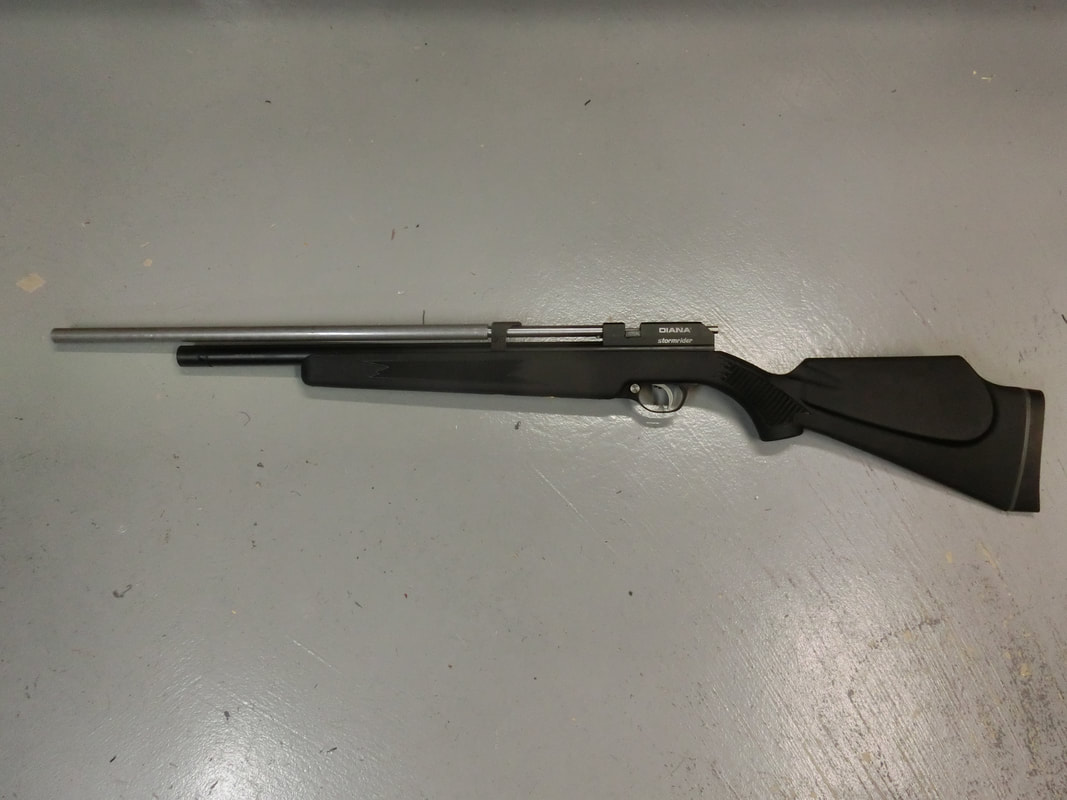
- Or, a Stormrider, that made its appearance in the "SouthPaw Super Plinker" entry exhibits an efficiency of 10.2 cc-bar/ft-lb.shooting at 13-15 ft-lbs
- Or an Avenge "X"
that yields an efficiency of 16.7 cc-bar/ft-lb at 52 ft-lbs at high power, or 16.4 cc-bar/ft-lb when shooting at 20 ft-lbs.

There are MANY factors affecting the efficiency of a PCP airgun: from barrel length to architecture of the barrel/tank connnection through the valve, to the hammer and valve itself, to the TP itself.
Each element needs dedication and care to optimize and maximize the "return for investment" in an airgun.

Whether you pump by hand, or use a compressor, the efficiency of your gun will dictate in large measure how much you can really enjoy it.
It's good to work hard to play hard, but it is even better to work smarter to play hard.

;-)
​
Simple fact of life.

Hope you enjoy the read, keep well and shoot straight!


HM
6 Comments

The "Nano-Strike" an exercise in efficiency

2/20/2026

7 Comments

 
Disclaimer:
Modifications made to this pistol were performed by an experienced professional airgunsmith. And, proved safe in THIS gun.
No warranties are implied nor extended.
We have no control of what you do on your own.
If you do decide to make ANY modification to an airgun, be conscious of which elements are under force or pressure and realize that, even a "little pre-compression" or as little as 10 BAR's CAN cause SERIOUS bodily harm.
These modifications have not been reviewed, nor approved by DIANA / M&G, BuckRail, or ALTAROS Air Solutions
Again: Be careful! You are the only guardian of your health and safety.

"In the beginning"

When someone asked if I could take a look at his Bandit pistol, I sort of reluctantly replied with my usual questions:
1.- What's wrong with it?
2.- What do you want to do with it?

Answers came back forthrightly:
The regulator was not working properly
The person is a professional wildlife manager, mainly of iguanas and other non-native/invasive species in Florida.

Now, THAT piqued my interest and I offered to do the job for free as a support to the Wildlife Department.
My friend answered that that was not necessary, and he would pay for "whatever was needed".

Not often does a gunsmith get a "Carte Blanche" to create something outstanding, and so, the project started.

Upon receipt of the pistol I could see that something was not right.
Initial tests showed MV's all over the place. And a very low shot count (barely one magazine of 7 shots) between fills.)
So, a disassembly was in order.

The Process Starts

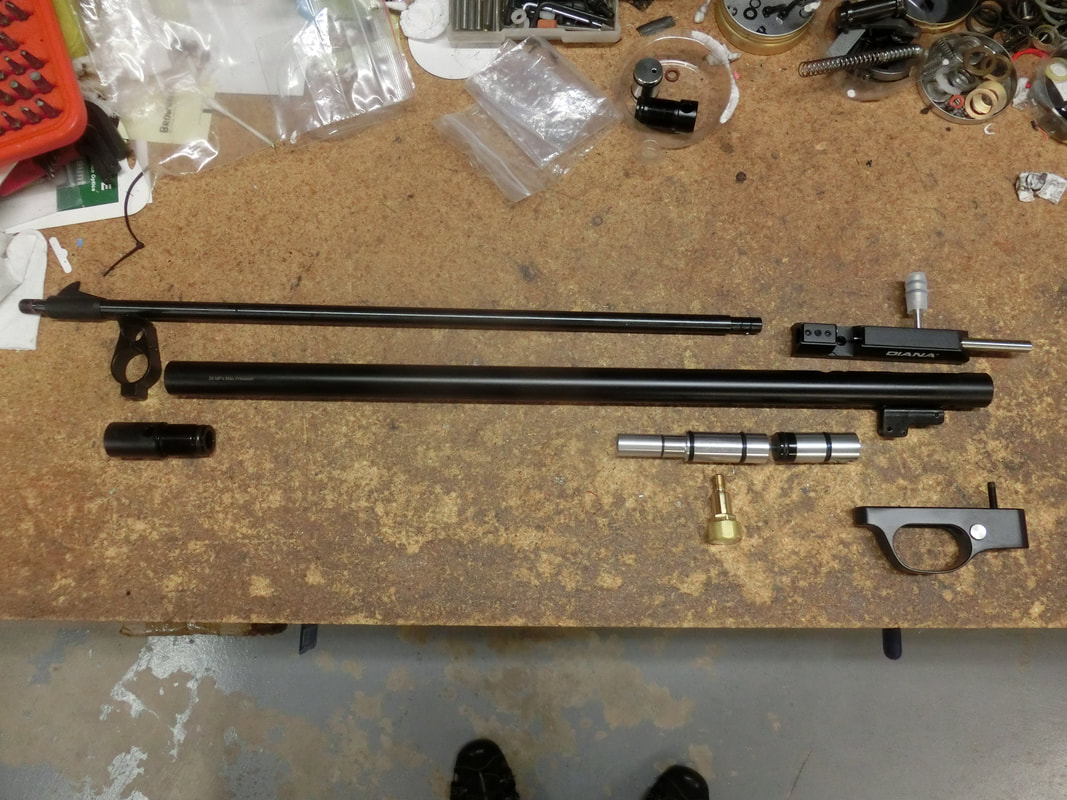
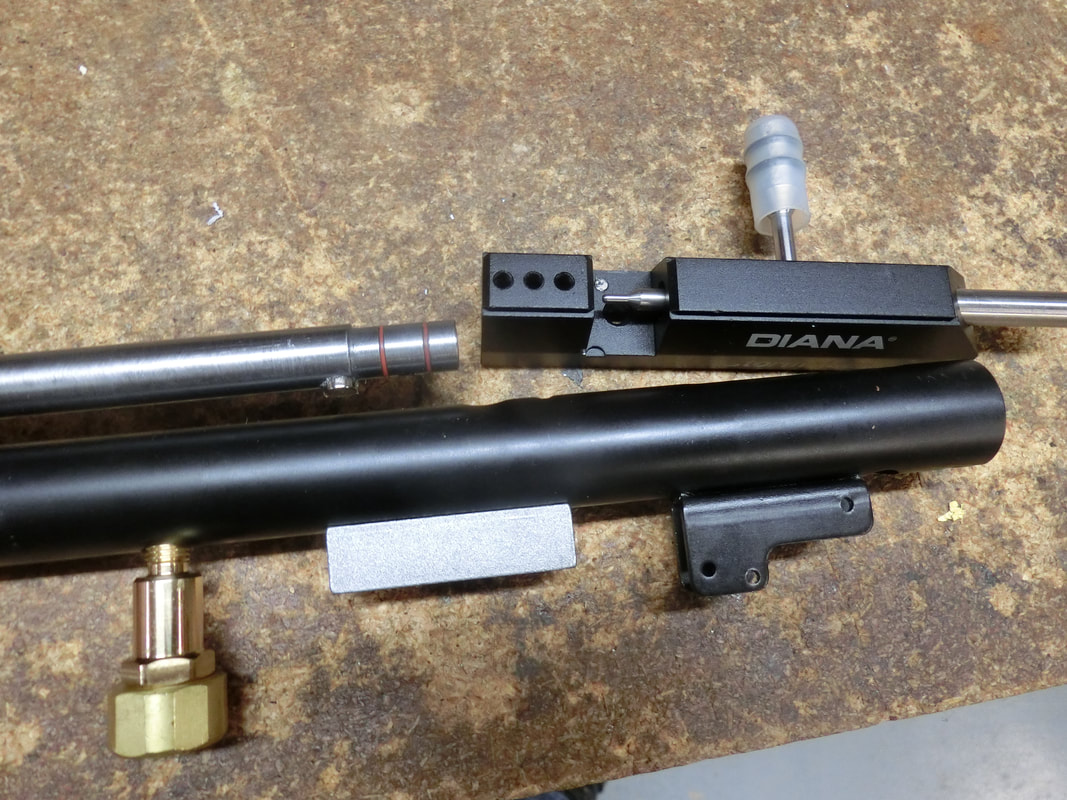
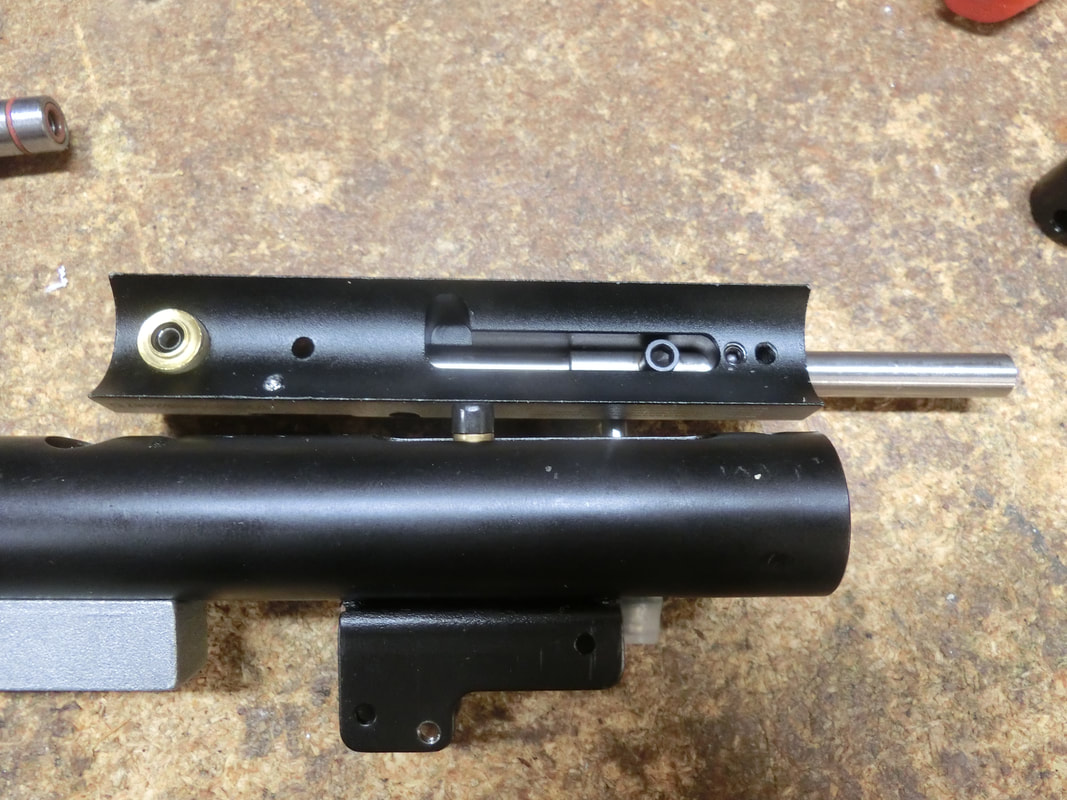
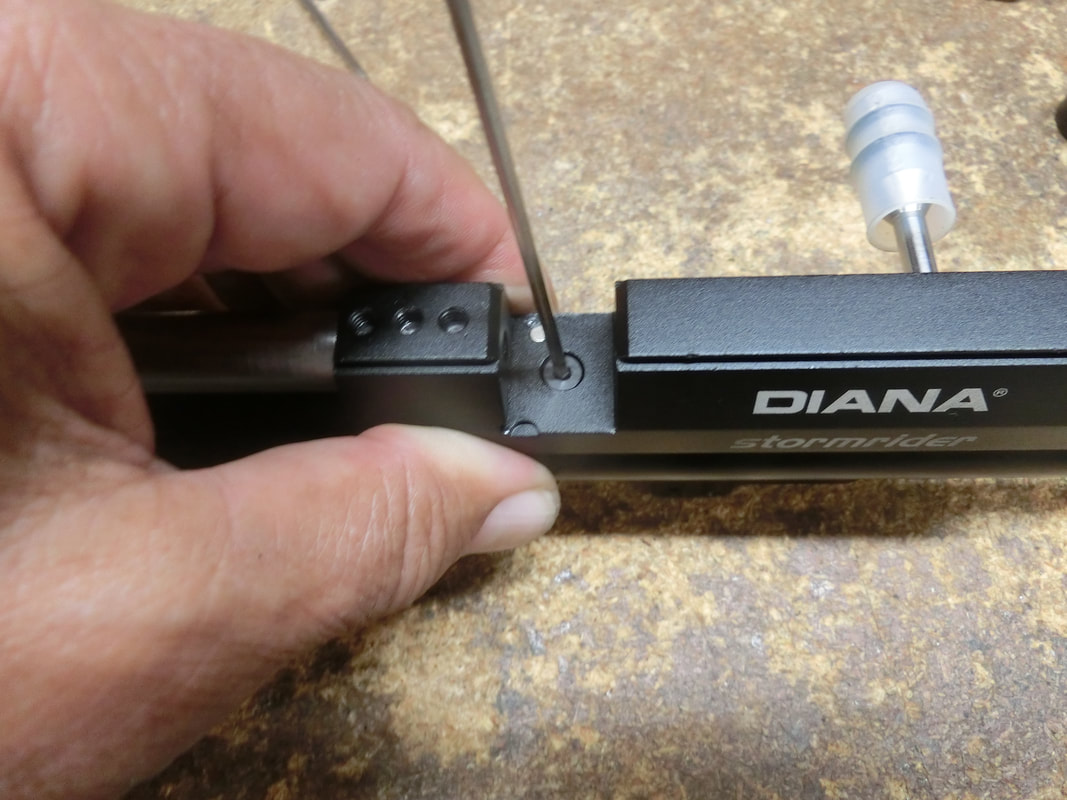
Picture
Part of the problem was the HUMA regulator and the "plenum" added. Dimensions simply didn't make sense, I searched in my ALTAROS regulator prototypes and found a very interesting one, vented and with the plenum already included. This was an experiment that did not pan out, but it could be the solution here.
Comparing the two "trains" I saw this:
Picture
At top is the HUMA regulator that seems very compact, but it wasn't working.The OEM valve on top was a bit smaller than the improved/HP Altaros valve (higher power), still, I decided to go with the OEM.
We also thought about using an extended tube, but the trigger arrangement would not allow it:
Picture
At the top is the OEM barrel, then the Stormrider-size tube and in the grip, the Bandit tube.​
Picture
As you can see, the brackets that hold the trigger parts in place are different.

So, a decision was made to keep the tube but use a longer barrel to improve efficiency.
An efficient airgun seldom needs a mod. Ineffiicent airguns do.
And we planned to make this a very efficient airgun,
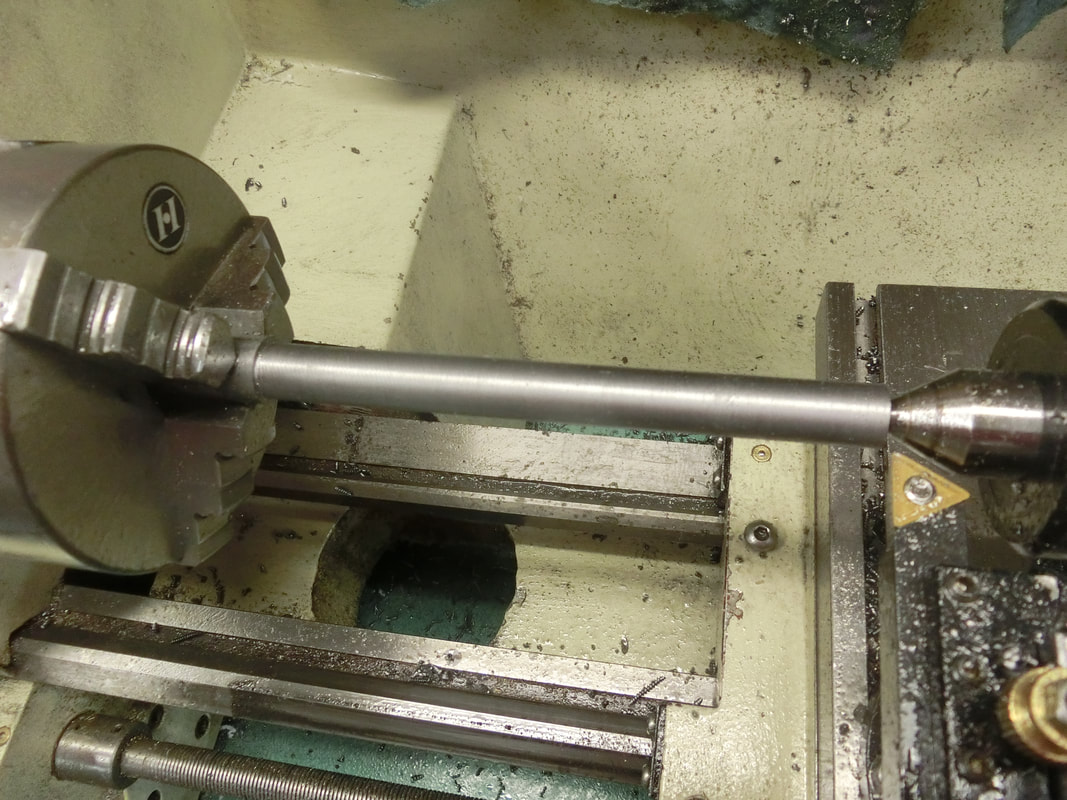
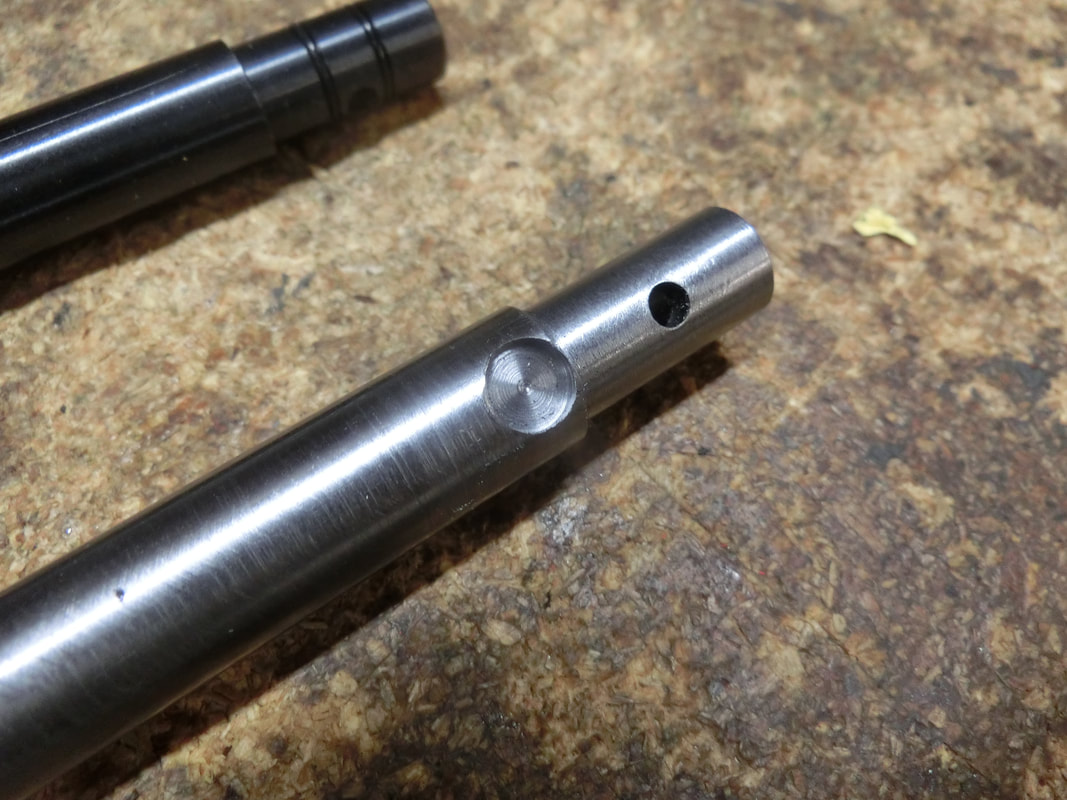
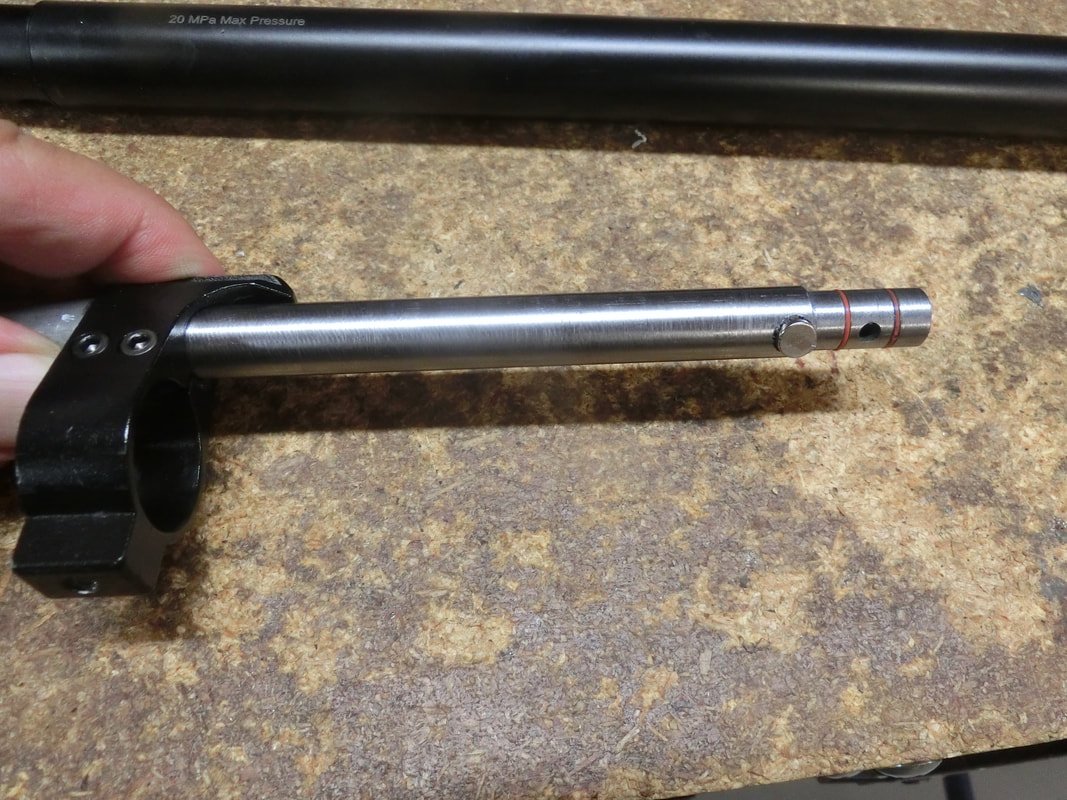
So, a Lothar Walther blank was sourced and we started on the preparation. A LOT of lathe and milling/drilling work goes into making a good barrel from a blank:
-Creating the shank
-Drilling transfer port and locator holes
-Making the glands for the Orings
- and, most important: creating a good "leade" that will allow the pellet to pass the TP and arrive to the rifling centered and unharmed.
Picture
After the shank is created and the TP has been drilled/milled, the "leade" has to be cut.
Picture
It's a slow process of trial and error, subsequent pellets are pressed into the leade to ensure that the pellet enters the rifling unscathed.
Picture
Once the head passes without any tear or undue deformation
Picture
A little more takes care of the skirt
Picture
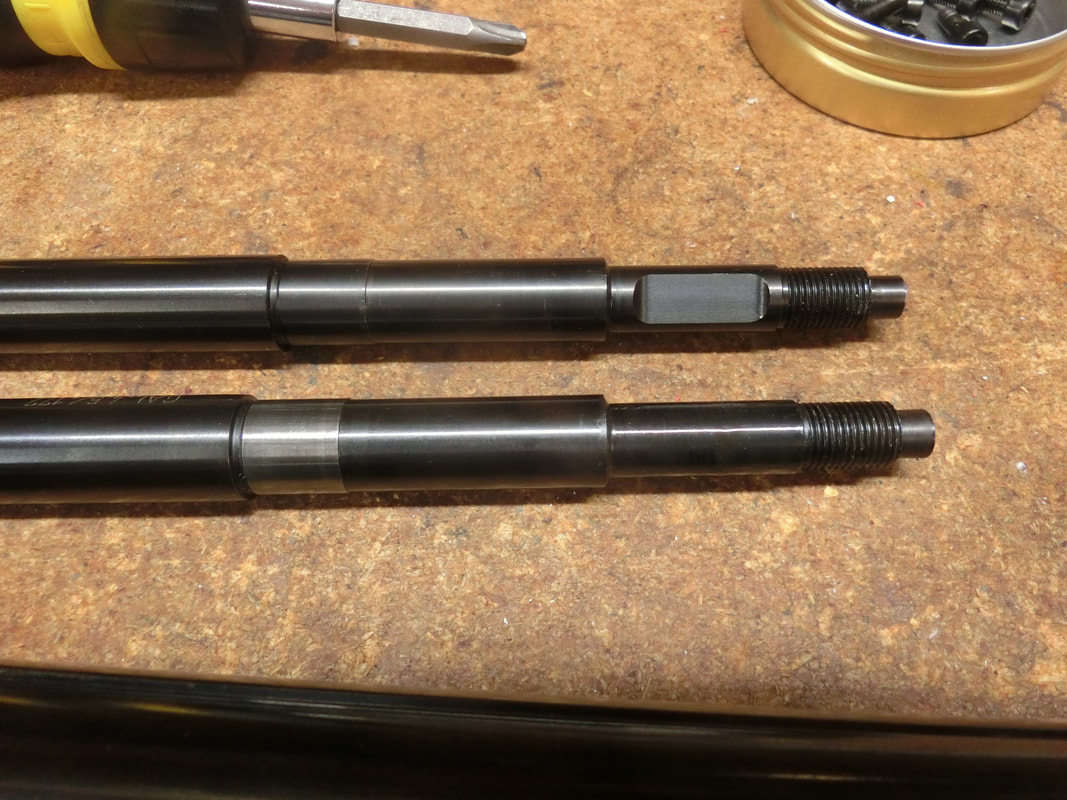
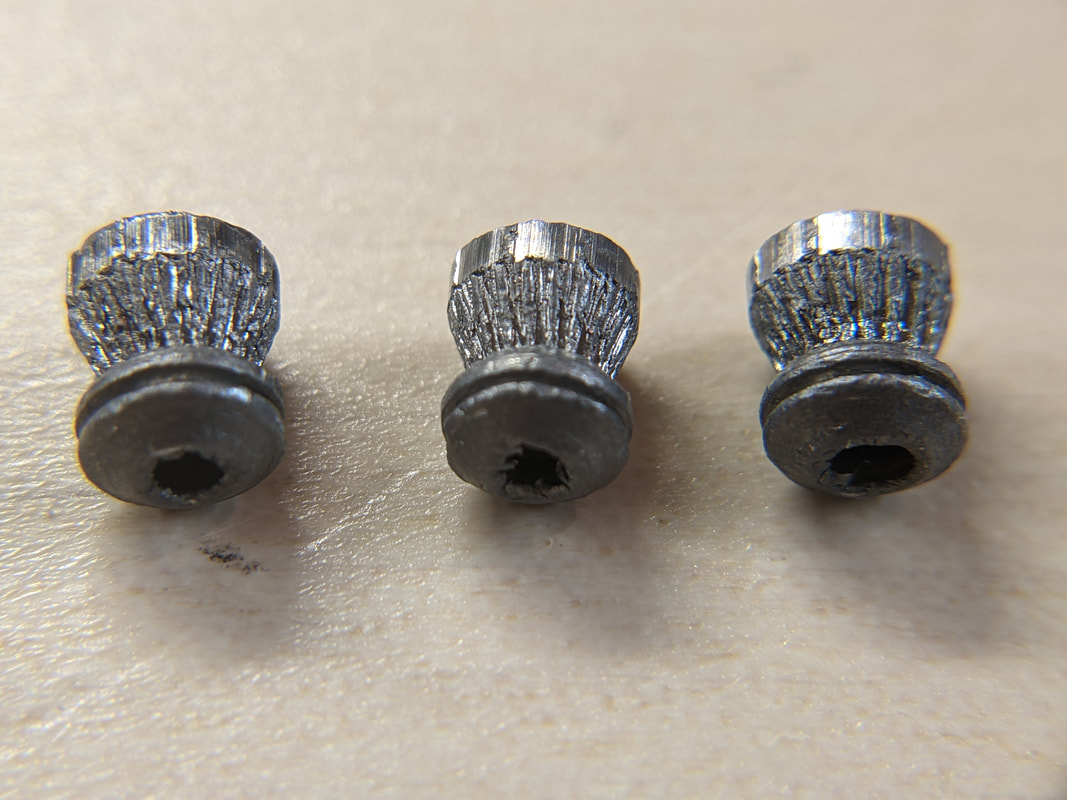
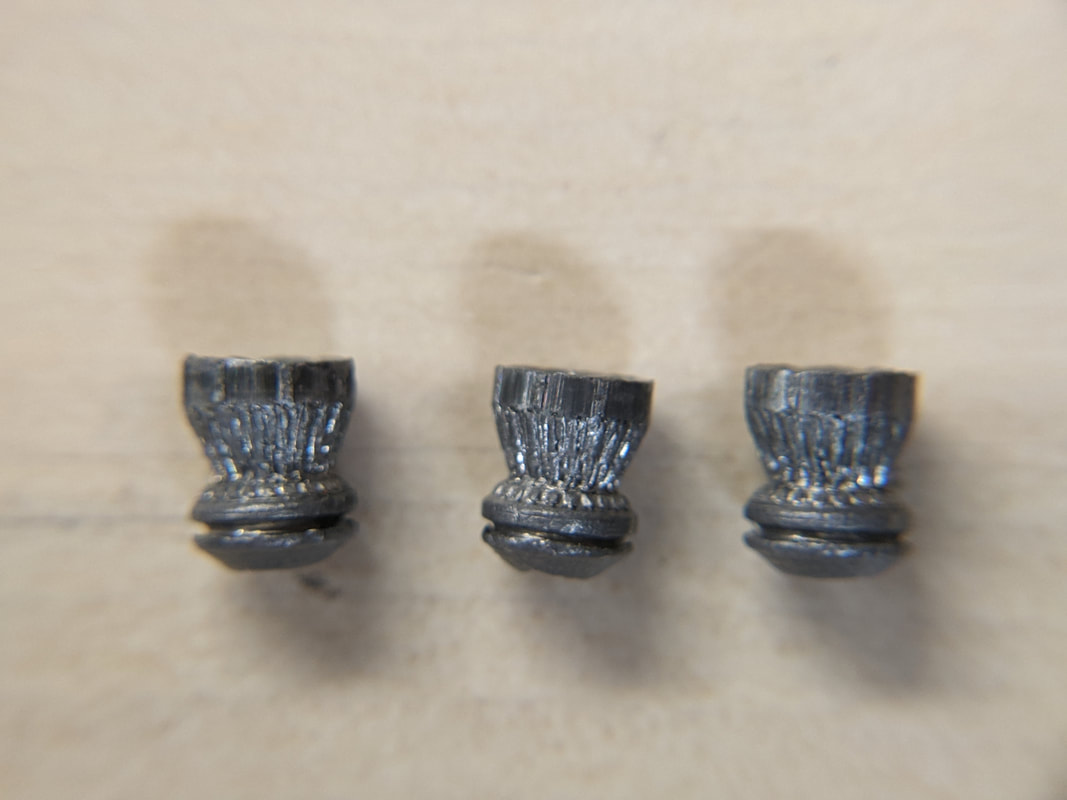
Testing with hard (Tin) pellets gives you a better idea. On the left, the OEM barrel, on the right the Lothar Walther
Picture
A view of the L-W riflng (this one is a traditionally rifled barrel) in 0.22" for a smaller caliber and high velocities, the Polygonal work better.
Picture
The new barrel is as long as the OEM WITH the mod. The blank was 16 mm's OD, as we planned on using a free floated barrel initially.
Picture
Cutting the ORings for the barrel seal also merits some attention. The glands need to be sized so that the insertion/extraction of the barrel will not cut or damage the ORings, in this case a bit more depth had to be given to the left gland.
Picture
Once the TP is properly "registered", it's time to drill the locator holes for the top of the action.
Picture
And the feeding can be tested. I like the SSS (Single shot shuttles) more out of habit than anything else, but I have found the magazines, for the most part, are troublemakers.
Picture
Once the action was an assembly, we could dedicate to the power source, this is the "train" that we settled in: Altaros vented regulator with plenum and the OEM valve
Picture
We started with a low pressure in the regulator (100 BAR in this case)
Picture
The valve and regulator were inserted in the usual manner for Altaros regulators
Picture
Air tightness and reg setting were tested / measured and we proceeded with testing
Picture
After some adjustments in the FFH unit, we were getting some decent speeds (for an 18.52 grs pellet)
And I thought I was done with it, LOL!

My friend had found the BuckRail airgun accessories page and wanted the "full Monty"

After some conversations with BuckRail, it was clear that they could not build a custom version of their "handguard", so considerable slimming of the barrel, and enlarging of the barrel channel in the handguard were in order.
Because milling plastic is a delicate exercise, it had to be done slowly and carefully
Picture
Taking careful measurements we arrived at the max OD that the piece coud receive, got a special cutter and proceeded SLOWLY
Picture
VERY slowly
Picture
REALLY slowly. Using a Stormrider air tube and some wooden pieces, we managed to keep the plastic printed piece in good / rigid grip and alignment.
Picture
After reducing the OD of the barrel substantially, we tested the fit and ensured that there was no pressure on the barrel at any point. That everything worked and that the fit was proper.
Picture
We also fit the stock support (what in a firearm would be the "buffer tube") using a specially designed and made adapter, so that adjustability of the FFH would be conserved.
Picture
And this was the semi-finished product. Semi-finished because my friend now wanted a mod.
Picture
So, we ended up with this. I have to admit it is a nice, clean, "racy" looking carbine.
At the same time this project was progressing, a group of friends were starting a thread in a forum about modifications to the Bandit and another about "Compact" hunting guns.
Problem is that there is "compact" and then there is "COMPACT"
Take a look at this picture:
Picture
From the Top: Ful size Nova Liberty, then a 3P / youth oriented Stormrider, then an Avenge "X" in semi-bullpup configuration, then a DIANA SkyHawk, also a semibullpup, but with shorter barrel and an airtube, and at the bottom, the Bandit conversion with the stock collapsed.
From 46" to 27" different purposes, different power levels, different architectures.
Interesting array of options we now have in our airguns.

If we compare the Bandit carbine to the other two that qualify as  "compact", we get this:
Picture
In this picture, the Bandit Carbine has its stock extended to "Adult size", and it is still shorter than the other two.
A few more pictures of details:
Picture
Attechment of BuckRail's stock support to the adapter
Picture
Stock extended
Picture
Stock and Grip Adapter setting
Picture
Junction of the forend/handguard with the grip adapter
Picture
Where it all comes together, action, barrel, handguard/forend, grip adapter, scope mounts and scope. Neat and clean.
Picture
And the muzzle end.

The results

All nice and dandy, yes, but what about performance?
A lot of airguns, especially in the low price brackets are very good looking, but when it is time to perform, they do not, so .... what about performance?

Well, I'll let the numbers speak for themselves:
Picture
From 230 BAR's (perfectly safe in THESE airguns) to the regulator pressure of 125 BAR, the little platform yields 14 perfectly good shots with sample Standard Deviations of between 6.1 fps to 3.3 fps over the 14 shots.

The efficiency of the power plant is quite good, yielding between 16.7 and 19.1 CC-BAR's/ft-lb

If we compare the efficiency of this little carbine to an AirVenturi "Micro Strike" (the only other platform that closely approaches this in dimensions and weight), as reviewed by my good friend Steve Sciali, the Micro Strike needs 41.8 CC-BAR's for every ft-lb delivered at the muzzle, so between 2  and 2½ times more effiicient.

I am already hearing some complainers voicing the objection: "¿Why care about efficiency? It's not like we handpump our airguns anymore, compressors are so cheap nowadays, why bother? Electricity is cheap!"

OK, yes, electricity is, in general, cheap; compared to what RF ammo costs. BUT, there are three aspects to be taken into account:
1.- Noise, if you are a hunter (as opposed to a game-sniper), you do not want excessive noise, and if an airgun is inefficient, where do you think the energy that is not put into the pellet goes?
Yes, some heat, yes; some vibrations (not so much in a PCP), yes, but mostly: NOISE! 
Steve comments that only ONE of his umpteen mods was capable of reducing the sound signature to decent levels. So, noise is one of the concerns in an inefficient PCP
2.- Compressors' lives are rated in hours. Filling this little carbine's 31.7 cc's available volume takes exactly 2 minutes with a Port-Air compressor. Filling the 80 cc's of the Micro-Strike, would take 2.5 times those 2 minutes or 5 minutes. 30 (yes, THIRTY) fills of the Bandit Carbine will take one hour of your compressor life. TWELVE fills of the MicroStrike will do the same.
Inexpensive compressors will last about 150-200 hours between services. So, taking 2½ times the fill times will reduce the number of fills between services to the compressor.
3.- Simply good engineering.

Of course, to each his own. To ME, it is important, especially in a "pesting" operation, to be able to take two magazines of shots per each refill. It carries a better "rythm" in the hunt, and allows less bother and strange noises.
IF I had a small "pony" bottle filled at 300 BAR's I can easily get a week's worth of shooting from an efficient gun, not so much with an inefficient one.

In the end, what should matter most to the USER, is the performance on target.

We have had miserable weather here in Maryland for the last month. We're barely seeing again our grass, and the forecast for this weekend is about 7" of snow. So I accepted an invitation to an indoor range just to test this gun.
Took a few of my special targets and proceeded to zero, check, and calibrate trajectory for this little carbine
Picture
This is the 10 yard zeroing target
Picture
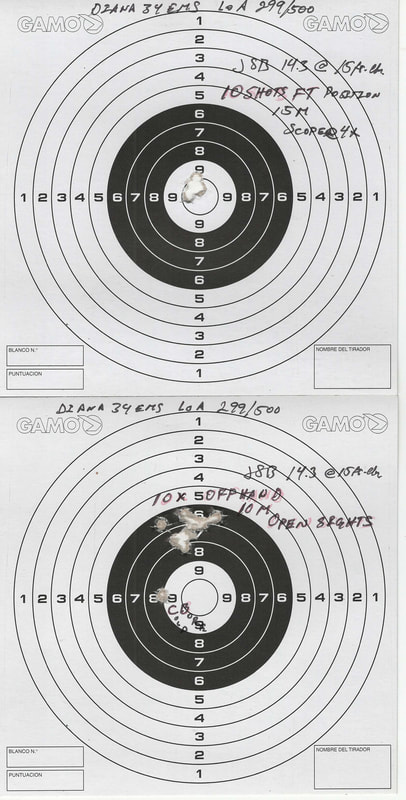
¾" high at 10 yards should be close at 15-> 20 yards, and I tested also the drop to 25, about 1"
Because the range is a "Pistol" range, the range officers objected to me shooting supported on the table. So all testing had to be done offhand:
Picture
5 shots at 20 yards, iguana is about lifesize, and the red circle is where, in my experience, you get a "lights out" shot.
Picture
Another 5 with a little heavier pellets
Picture
Last test with the Predator PolyMags, not heavier but slightly less efficient in the barrel, this points to the fact of having a good scope with multiple aimpoints.

Conclusion

It was a GREAT project, I enjoyed it immensely, even in the face of the huge challenge presented by the small reservoir and the intrusion of the regulator into it.
My friend tells me he is happy, and that is what matters.
Hopefully, he will find the time to write a small "Guest Blog" for us about his "escapades" with the Bandit Carbine that, now, has a new name: The "Nano Strike"

;-)

Keep well and shoot straight!


HM

ADDENDA
If copying is the sincerest form of flattery....

A friend is touring IWA.

But he keeps abreast of what we do here on this side of the pond.

And, he just sent me these pictures:
Picture
Picture
Picture
Should we say that "brilliant minds think alike" or . . . 

It's going to be interesting to see the performance figures of this.

;-)

​HM
7 Comments
<<Previous
Forward>>

    Hector Medina

    2012 US National WFTF Spring Piston Champion
    2012 WFTF Spring Piston Grand Prix Winner
    2013 World's WFTF Spring Piston 7th place
    2014 Texas State WFTF Piston Champion
    2014 World's WFTF Spring Piston 5th place.
    2015 Maine State Champion WFTF Piston
    2015 Massachusetts State Champion WFTF Piston
    2015 New York State Champion WFTF Piston
    2015 US National WFTF Piston 2nd Place
    2016 Canadian WFTF Piston Champion
    2016 Pyramyd Air Cup WFTF Piston 1st Place
    2017 US Nationals Open Piston 3rd Place
    2018 WFTC's Member of Team USA Champion Springers
    2018 WFTC's 4th place Veteran Springer
    2020 Puerto Rico GP Piston First Place
    2020 NC State Championships 1st Place Piston
    2022 Maryland State Champion WFTF 
    2022 WFTC's Italy Member of TEAM USA 2nd place Springers
    2022 WFTC's Italy
    2nd Place Veteran Springers
    2023 WFTC's South Africa Member TEAM USA 1st place Springers
    2023 WFTC's South Africa
    2nd Place Veteran Springers

    Archives

    February 2026
    November 2025
    June 2025
    May 2025
    March 2025
    February 2025
    January 2025
    December 2024
    October 2024
    September 2024
    June 2024
    May 2024
    February 2024
    October 2023
    September 2023
    August 2023
    May 2023
    March 2023
    December 2022
    August 2022
    May 2022
    April 2022
    February 2022
    August 2021
    July 2021
    June 2021
    May 2021
    April 2021
    March 2021
    February 2021
    October 2020
    September 2020
    August 2020
    July 2020
    June 2020
    May 2020
    April 2020
    March 2020
    February 2020
    January 2020
    December 2019
    November 2019
    September 2019
    August 2019
    July 2019
    May 2019
    April 2019
    January 2019
    December 2018
    November 2018
    October 2018
    September 2018
    August 2018
    June 2018
    May 2018
    April 2018
    March 2018
    February 2018
    January 2018
    December 2017
    November 2017
    October 2017
    September 2017
    March 2017
    December 2016
    October 2016
    September 2016
    July 2016
    June 2016
    March 2016
    January 2016
    December 2015
    November 2015
    October 2015
    September 2015
    August 2015
    June 2015
    May 2015
    April 2015
    March 2015
    February 2015
    January 2015
    December 2014
    November 2014
    October 2014
    August 2014
    July 2014
    June 2014
    May 2014
    March 2014
    February 2014
    December 2013
    November 2013
    October 2013
    September 2013

    Categories

    All
    Events
    Gear
    Hunting
    Tests

    RSS Feed

Proudly powered by Weebly