Connecticut Custom Airguns
  • Welcome!
  • Hector's Airgun Blog
  • Products and Products Blog
    • One-Off's
    • The "Héctors Special'" scope by Sightron
    • K1050i FT
    • The Hex Louver or "Secret Sunshade"
    • Pellet Path Calculator >
      • Questions, Answers and Comments on P-P Calc
      • Privacy Policy for PP-Calc
    • The Nautilus SideWheel
    • The X-10 TiltMeter
  • Zimmer-Silhouetten
    • Results 2017-2018
    • Results 2016-2017
    • Results 2015-2016
    • Results 2014-2015
    • Results 2013-2014
  • References and Links
  • Contact us
  • Store

Hector's Airgun Blog

Where we discuss, CIVIILY,  anything airgun.

Return Home

20 years of Progress; and the "Future"?

10/15/2024

14 Comments


A comparison between the DIANA 46 and the 430

Sometimes it is interesting to look at history and assess how much we have advanced (progressed), or retreated (regressed) in the things we "make".
As we all know, and feel, just a few decades ago changes took, well, decades; nowadays change seems to come in a matter of days.

The airgun industry is not too different. It just happens that they still take between 3 and 5 years to bring a project to fruition.
So, this time around we will look at two guns closely related to each other, as they were designed to occupy more or less the same "ecological niche" within the airgun "biosphere".

On one hand, the original "classy Lady" role was played by the DIANA 46.
From the very late "nineties", to the early "tens", the DIANA 46 came out in 2 basic models and in some "juicy" variations that defied imagination.
The two basic models were the rifle, and the carbine.
All the carbines came out in a full length "Mannlicher" style stock.
The rifles came out in "half stocks".
For TWENTY years that the gun was in production, several VERY SMALL runs of "Luxus", "Prestige", and at least one (AFAIR) was made in "Royal" grades.

With prices to match. The Luxus retailed for well over 1k$ and the Prestige for over 2k$, the Royal was auctioned and it is unknown how much it fetched and where it is. The Luxus changed the checkering for "Ferlach style" fish-scales,  the Prestige changed the borderlines for carefully sculpted oak leaves and the checkering for medium/small game scenes. Truly for plutocrats.
Most, however, came out in the rifle / half stock format that was, in itself, quite agreeable to the eye and the hand.
It embodied the quintessential Gentleman's Birding rifle.
Picture
This specific 46 suffers from a cocking lever failure, we'll look into it in detail later
After the "exit" of the 46 from the line, many saw the 460 Magnum as the successor to the 46, but that was wrong.
Th 460 Magnum was designed from the ground up to be a powerhouse. Under no circumstances would it be reasonable to dedicate such a slender "Thunder of Zeus" to the 5.5 to 12 ft-lbs region.
The 460 was a success. Building upon the power delivered by the bore and stroke of the 350, the fixed barrel version was well received by the market. At last a piston airgun that delivered solid 23 ft-lbs. in 0.22" cal. WITHOUT dieseling/combustion. No need for compressors, hoses and tanks. That limit is important because pellets themselves become unstable at much above 875 fps and there was no sense in creating more power just to waste precision and accuracy.
So, it took some time, and by the late "tens" the 430 came onto its own. This one followed more or less the same developmental path of the 460. It took the bore and stroke of the 280 (its break-barrel testbench) and put them into a fixed barrel architecture.
The 46 was slim because the use of a pop-up loading port allowed the dispensation of the sliding compression chamber of the 460. And, so, when the 430 was born, it was a bit heavier and bit less "svelte".
​

Still the beauty of a Mannlicher stocked 430 is truly something to behold.​
Picture
And comparing them side by side, the 430 (L in this case) and the 46, neither yields anything to the other:
Picture
In this picture, the 46 has been repaired with a new cocking lever.
Of course we can see the more "modern" design of the 430. More curvaceous, organic, lines, fully ambidextrous; while the 46 exhibits the classical beauty of the 70's: angular lines, clearly delineated MonteCarlo (above), four points checkering, etc.
Yes, the 430 is a BIT shorter. Remember we "lost" the long transfer port that was the pop-up loading port.

Now, both the 46 and the 460 had problems with the cocking lever.

Originally designed for the 46, the forces required for the 460 to work at full power were a bit much, the "composite" construction of the cocking levers didn't help either. Outside the German market, that is mostly limited to 5.5 ft-lbs, the rest of the world saw more than a few cocking levers bent, or broken.
When the time came to change the "Type" of the rifle (from T-05 to T-06), DIANA took advantage and redesigned the cocking lever:
Picture
On top, the T06 cocking lever, on the bottom, the T05 cocking lever. Which one do you think will be stronger?
Picture
Here we can see how the T05 cocking lever (bottom) had a tendency to deviate from straight.
BUT, aesthetics is not what we're after here. What we are interested is in the mechanical aspects and the performance side, so, let's leave the appearance and get into the actual machine.

When the 430 came out, shooters started to complain about the cocking effort required.
Of course, in a Stutzen / Bergstutzen, with a shorter barrel and, consequently, a shorter cocking lever, it was expected, but in the rifle?
Hhhhmmmmm not so much.

And yet, in the 46, it's incredibly easy to cock the mainspring, and getting 12 ft-lbs out of the engine is not a problem even with the super-long transfer port.
​So, ¿WHY?

The situation is quite obvious when seen, fully cocked, side by side:
Picture
In this picture, you can see that the ARC of travel for the 46's cocking lever is well over 140° While for the 430L it is a little less than 110°
And here comes one of the peculiarities of engineering that is not obvious to those that do not USE the products they design:
Changing one thing WILL change everything else.

Remember we said that the 430 and the 430L were a bit shorter than the 46?
Well, shortening the fore-section of the rifle moved the "fulcrum"  point of the lever back, shortening the cocking stroke, shortening the arc, and INCREASING in tangential proportion (which means that any decrease will comport an "out of proportion" increase), in the cocking force needed to fully load the mainspring.

Efforts were made to lengthen the cocking lever when the 430L was brought out but, alas, the market didn't think it was enough. I've written several articles about the 430 Stutzen and the 430L, so I will not elaborate a lot more on them.

NOW; when this 46 arrived, quite candidly, it was a shock for me.
The owner had referred to it as the "RWS Underlever", so I took it to be the 460, after all, precious few 46's were sold into the US; probably a result of a very bad "marketing stunt" where the  RWS people (then the responsible party for US marketing and sales) brought out the 46 as a "direct competition" to the TX-200.
In my conversations, neither Herr Wirth, nor Herr Zedler (successive CEO's of M&G), ever spoke on those terms.

So, when I unpacked the rifle and saw it was a 46, my heart sank. Don't get me wrong, I love the model, had one many years ago and when I moved to the US, it had to be sold and stay back in Mexico.
Soooooo, ¿why the apprehension?
​There are precious few spare parts anywhere in the world for the 46.
We, the owner and I, communicated with each other, set a budget, and the decision was made to move forward with the repair.
Hunting for the spare part

The internet has been a mixed "tool" for humanity.
On one hand, it allows us to reach much further out in our searches. Make friends with people we have never met, learn things we would have never learnt, etc.
On the other, it is a constant source of worries because between malware, frauds, extortions, easy money laundering, and other bad actors, in a way, it has become a "jungle" in itself, where survival is a matter of preparedness, knowledge and strength.
In the end, a tool cannot be too different from its creators, and so, it's as flawed as humanity itself.

Anyway, beyond the philosophy, through the internet we were able to source from Europe, a spare lever for the 46.
To my delight, when the part arrived, I noted that it was completely made of steel. No aluminum there.
Sure, the gun weighs a bit more, but the strength afforded by the all steel part is a worthwhile tradeoff if you are shooting at anything above 7.5 ft-lbs.


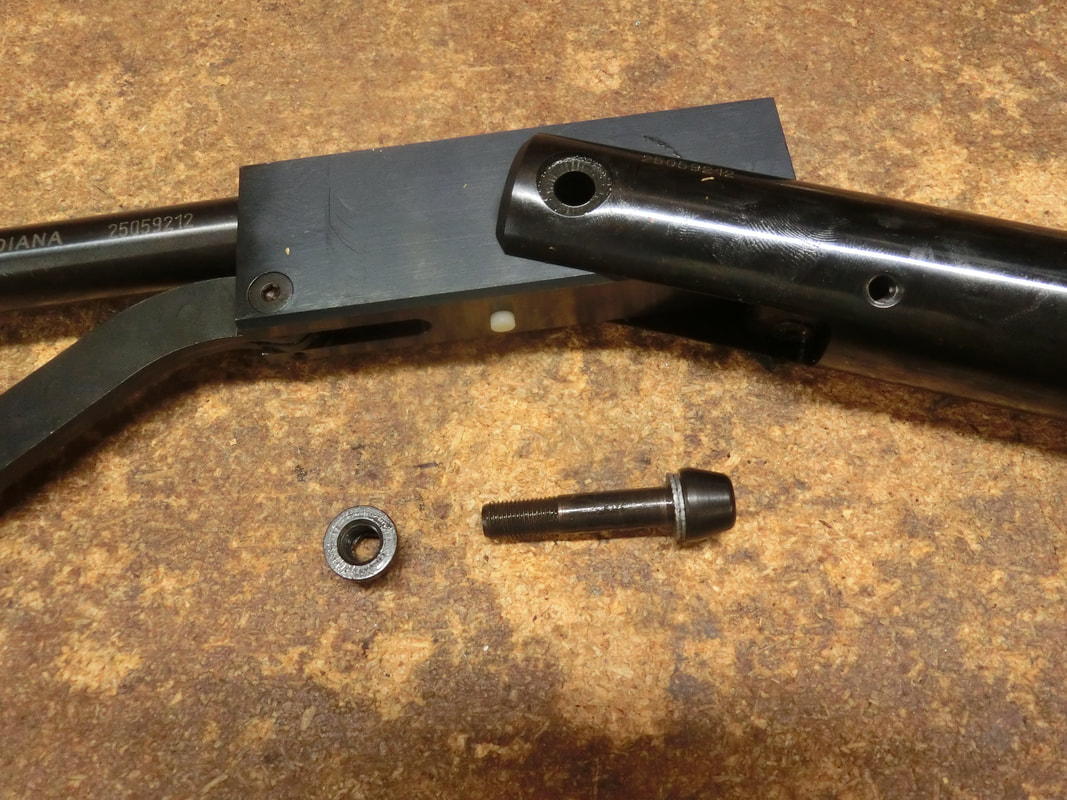
Once the part arrived, it was not a big problem to swap it. Some polishing here and there, and new pins with custom washers to prevent the pins from travelling sideways too much and the little carbine was back in working order.

My instructions were to repair the little rifle, and so I limited myself to that, no changes in spring, piston, seals, ORings, etc. Just a small adjustment to the T01 trigger that was a little creepy, and the 46 was "up to snuff".

​The rifle went from this:
Picture
To this:
Picture
What cannot be seen in the pictures is that we adjusted the ball in the lever detente:
Picture
It is important to note that the ratchet was added not because great force is needed, but because great CONTROL is needed, the ball lies at the end of a spring'ed bolt. That bolt runs in a piece that is plastic.
Excessive force one way or another can damage the muzzle piece, or tighten too much the bolt and damage the lips where the ball turns:
Picture
Setting the detente at the best position requires high control of the torque applied, there is little tolerance in this.

Also not obvious in the picture of the complete rifle is that these rifles deserve better pins than the OEM ones.
On one hand, the OEM ones usually are made to tolerances that favour the "-" part because that makes for ease of assembling.
On the other, all mechanical things wear out. A high grade of steel pin (hardened and ground), will fit better and wear out less the carrier parts because it is polished and, properly lubed, will not hold "grit/dust".
So, you need to start from a full size hardened steel "dowel", cut it with a carborundum hacksaw:
Picture
Then use carborundum and diamond files to trim/round//chamfer the ends, and to create the slot for the C Clip:
Picture
The finished clip has the proper chamfers to be inserted (right to left) and the proper flat at one side of the notch to lock the C-Clip
Picture
Handmade pins may look "funky", but they are easier to insert, easier to install/locate. After all there is not much room in the cocking lever linkage:
Picture
I was curious to evaluate how a 20 year old spring would do, and so, I took some Chrono readings:
Picture
For the small size of the rifle, this is remarkable performance. The 0.22" cal does have more expansion ratio in the barrel, so a higher than normal energy was expected, but this surpasses the expectations.
The tests also highlighted a few important points:
a) the long TP is more detrimental in 0.177" cal than in the 0.22"
b) the barrel is on the "fatter" side, the GAMO Match, that seal at the front gave impressive performance on the energy side, not too good at the target.
c) the JSB's were at the bottom of Energy, though they did yield the better consistency.
d) the performance of the GTO's was no surprise.

I really do not know why this pellet is not more popular.
I have written a few articles on the GTO, and in 0.22" it really performs well.
Made by JSB totally in Tin (Sn), it is a good balance between caliber, weight, energy retention at range and accuracy.

Now, how did the gun perform at distance?

Well, we have already said that this was designed as the "Gentleman's birding carbine" so we will not test at long range, but within the range where you can expect to shoot birds or tree dwellers (25 meters), it does quite well:
Picture
The Super H Points disappointed in this carbine, probably a function of the slightly large bore.
Same for the Crosman Copperhead Pointed.
The GTO's however, performed creditably well.
When compared with an OEM D430L shooting the pellets that it likes best (QYS 8.49's), the groups are similar and perfectly adequate to the purpose at hand.
Those little black bullseyes are a bit under ½", so head shots in anything worth taking with an airgun out to 25 meters (27 yards), would not be an issue.
BTW, the groups were shot from the knee, no supports used and DO
 note that I am not using my FT-ready 430L, as that would be a totally unfair comparison.
​

Conclusion and the "Future":

So, have we advanced in these last 20 years?
My personal conclusion is that: NO

¿Was the 46 ahead of its time? In a way, yes.

WHY was it taken off the line? Because the market demanded more power and the little seals in the Pop-Up TP had a tendency to "fly off" (a problem that is easily corrected).

¿Did the replacement (430) lived up to expectation? 
Not really. It COULD have. Some improvement was gained with the 430L but, still, the market did not recognize it and, before the third iteration could come to the market, that one also fell off the cliff.

So, what's in the future?
At this point in time, I really do not know.

I THINK that M&G should (as far as the Performance line is concerned):
- keep the D54 AirKing Pro, the 460 Mag, and the 48 in full production
- return to the 34 Classic because the EMS, as great as the concept is, simply does not align to current M&G strategy, philosophy, and/or operational procedures.
- launch TWO specific FT oriented models; one based on the D430, and another based on the 54.

¿Why FT?
Ford, Audi, Renault, and some other car brands have made Racing cars. From LeMans, to Nürburgring, to F1
¿Why? 
Because, as brands, you need to have a "Prestige", and show the world that you are at the forefront of technology.

FT is to the airgun world what Racing is to the auto world. The place where technologies are TRULY put to the test. Something that not even Bench Rest can achieve.

¿Are they market ready products? Nope!, but, you know? it DOES NOT matter.
Those "specials" establish a brand, create "buzz"; make, otherwise unaware persons, aware of the brand AND the activity.
In few words, those "specials" EXPAND the market. It is not a question of market share, it should be a question of Market SIZE.

The spring-piston lines think that they are competing with the PCP's, that's why most of the brands have both lines.

Truth is that there are a LOT of shooters out there that dislike the idea of compressors, pumps, hoses, air tanks/time bombs, and complications like that. That is the domain of die-hard airgunners.

Spring piston makers should be concentrated on making spring-pisotn guns that appeal to the average powder burner or non-airgunner.
From my own experience, most of the high end projects come from people that want to shoot an airgun that gives nothing to their RF's (within 50-75 yards).  AND do NOT want a PCP.

THAT should be the objective.

AND, M&G/DIANA is uniquely positioned to fulfill that need/want.

Will they see it? 

Time will tell.

Keep well and shoot straight!


HM
14 Comments

The Rifle that COULD have saved Walther's springers

9/28/2024

2 Comments

 
Disclaimer.-
The conversion done here was carried out by a professional gunsmith. No warranties implied, or otherwise, are intended in this article. 
Do NOT attempt this conversion if you are not completely qualified to do so.
This conversion has NOT been sanctioned by Carl Walther or UMAREX

This conversion proved safe IN THE GUN that it was performed. We cannot guarantee that all other guns will receive the conversion in the same way.
Please do not ask for measurements or dimensions, 
Connecticut Custom Airguns cannot provide these data.
All designs and parts' shapes and dimensions are proprietary to 
CCA and Carl Walther brand as applicable.
Background:
In the course of history, it often happens that when an entity; be it a corporation, a person, or a country, is close to the end, the entity performs their best.
When talking about spring-piston airguns, a friend has accurately commented that they are either "breaking in" or "breaking down".
Some years ago (1993), the company Carl Walther GmBH was acquired by UMAREX., the condition however was that the "Olympic and Target Style" rifles would be kept in a separate division that would be independent and that the firearms division would not get into the airguns.
So, under the guidance of the "new management" at UMAREX, the sporting section of the company began the development of a new line of spring-piston airguns.
We have already commented on the LGV and the LGU in a number of our entries, so we will not go there. We are, also, not interested in the lower line of rifles that UMAREX brought to the market to compete on price (Terrus, Parrus, etc.).

What "piqued" our interest some years ago was the very "Last Hurrah!" of the German company.
A somewhat "simplified" version of the LGV, and the last of a line that started back in the 1960's.

And I am talking here of the Walther "Century Varmint"

A very rare rifle that, AFAIK, was not even offered for sale in the USA in any appreciable numbers.

​​I had to purchase it from Krale in the Netherlands:
Picture
Of course with shipping and banking charges, it came in at a bit more, but still, this price was something that realistically COULD have been paid by a good many precision interested shooters.

So, after some waiting, and a lot of tinkering, I ended up with this beastie:
Picture
From the outside it pretty much resembles the LGV, similar outside contours; and the tell-tale unlocking lever in the breech-block (where the "V" comes from since the 60's) .
The stock also resembles the Varmint stock that was sold as an accessory for the LGU.
Now, mechanically speaking there are strong differences between the LG "family" and the Century Varmint.
I have taken the liberty to use an Exploded parts Diagram from the Bagnall and Kirkwood website, they offer some spare parts, so the link is always useful:
Picture
B&K were sent an EMail with a respectful request to use this diagram in this article. Good time was allowed for them to answer. Without an objection, it is used here in the spirit of "Fair use" and with full respect of their copyright.
The first thing you may notice is that this piston does NOT have a stem.
So, naturally, the trigger's sear is a sort of "ramp" that goes up and locks the piston at the skirt's edge. When the sear breaks, the ramp is pushed forwards by the piston's skirt and then it can fall down, freeing the piston that is pushed by the mainspring, to fly forward, completing the spring decompression fase of the cycle and compressing the air in the compression chamber.
In opposition to the LGV, this gun does NOT have an inserted "Sleeve" to form a compression  chamber of smaller bore. This piston, the seal and the compression chamber are all 28 mm's, while the piston, ID of the compression chamber and seal of the LGV are 25 mm's

"Cognoscenti" among us will immediately say "that is no good!" And they would be right from the POV of shooters that are extremely happy with guns that deliver truly smooth power at 10-12 ft-lbs. and weigh (in practical FT garb, between 15 and 20 lbs.

BUT, this gun was not designed for those shooters.
This gun was designed to put out between 12 and 14 ft-lbs with good accuracy and medium weight at a low /  median cost.
In reality it achieved all of these goals. It weighed less than the LGV because it did not use a sleeve. It delivered more "stable" power because the swept volume of a 28 mm piston can do better than a 25 mm's piston with the same pressure. And it cost substantially less than the LGV because the piston was simpler, the trigger housing smaller, the parts less complicated, and the rest of the parts were less sophisticated.

Those "Cognoscenti" shooters received with a cold shoulder the LGV and then the LGU, and some of them are now lamenting not having purchased one (of each) .

Inevitably, the conclusion for "Firma Walther" was that the market was not ready for high quality springers.

At any cost.

And, in a way, they were right, only recently have high quality spring-piston airguns achieved that price bracket, first the DIANA 54 and now the AA TX-200 US.

So, after a VERY short run (something in the LOW hundreds), the WHOLE of the Walther Spring-Piston rifles was removed from the roster.

So, WHY did this rifle failed to save the line?

The trigger.

I had always wondered why German airguns from the year 2K forwards, seemed to be designed by people that have NO IDEA of what shooting is all about.
Until I went to Germany.

With the "remodelling" of the whole country (as the "Berlin Wall" fell), a multitude of elder workers at all levels were displaced by younger persons with degrees and PC - CAD capabilities which seemed to be able to solve everything from the design phase. The solutions proposed made sense from the materials, production, and engineering sides. "Wunderbar!" ¿no?

Well, no. A lot of those solutions made no sense once analyzed from the shooters/tinkerers/gunsmiths POV's

And this is the perfect example. If you look at part 601.200.08.1 you see a "well designed trigger blade"
Except that it is made of plastic. Not only plastic, it is "structural" plastic, meaning it is not even solid.
AND, if a lot of shooters protested and cried their hearts out when DIANA came out with the T01 plastic trigger blade that is stout, rigid, and, more importantly for us gunsmiths: Customizable....
This trigger blade is a joke.

The rest of the gun is a masterpiece. The barrel of the one I have is good, accurate and stable. The Muzzle piece, being threaded and not having a particular orientation, can be used as a Harmonics Tuner. The lock at the breech block is taken directly from the LGV, so it is quality.
Guide, spring, tophat, piston, seal, everything mechanical is truly an engineering achievement.

But that trigger!.....

Even the stock, yes they are ALL synthetic (ALL Century Varmint stocks I've seen are Synthetic, not to be confused with the Century LGV that is a different gun altogether, that has both, wood and synthetic stocks); they fit well, are truly ambidextrous, and make shooting comfy.
I did not resist the temptation and improved the stock somewhat, but we'll come to that later.

Let's look at the Shakespearean "Fatal Flaw" of this rifle.
Picture
Theoretically an adjustable two stage trigger; when we open it we see this:
Picture
In the picture above, the two springs (one for the lower lever and the other for the trigger blade) have been removed for clarity.
Do note that the sear is the "ramp" we talked about and that it has an elongated hole that allows is to move aft and fore with the cocking cycle.
The steel bushing on top gives strength to the assembly, aligns the piston's skirt and works as a retention point for the skirt. Between the bushing and the ramp, the piston cannot go forwards without a trigger pull.
In usage, the trigger is only adjustable so much, and definitely not up to what is required for precision shooting.

​We need to remember that hunting with an airgun is an exercise in precision because we cannot count on energy to do the job for us. Placement is everything.

Part of the fault lies in the adjustment screw, it is too short and abuts before the trigger can become really crisp., so we changed that screw:
Picture
A healthy coat of Vibra-Tite ensures that the adjustment does not "disadjusts" by itself.

And we need ANOTHER screw to actually make it sensitive, so we added a nut:
Picture
​ AND a screw:
Picture
Since the blade is very thin molded plastic, we used a manual drill to avoid mishaps.

Could we have made a metal trigger? Yes, at considerable cost in time. Time that I did not have.

Once that was done, we could tackle the pellet selection process.
We tested some pellets then made a worksheet and sorted by energy levels. It often happens that the best performing pellet is at the top or top 3 of the energy performances of any given spring gun.
Picture
In this particular case, the A-A Field Diabolo did give the best ME, but at the cost of a higher sSD (sample Standard Deviation - 18% higher-). AND it also happened that in testing at the target (at 25 m / 27 yards), some groups were VERY good, some VERY bad. I suspect that this particular tin was not the brightest candle in the chandelier. Perhaps other tins may behave better, but in THIS case, the H&N B-8 were the best, more on that later.
Once the pellet was chosen, the muzzle piece was "tuned" using calibrated washers. The rifle needed less than 0.2 of a mm to go from good to great results (you can barely see the separation/washer in the picture) and what is important is not the results here, but the fact that the muzzle piece CAN be tuned to other pellets or other pellet batches.
Picture
I mentioned that the stock had been "improved", so let's talk here about the stock and the interfase between stock and action.
In spring-piston airguns, one of the main enemies of consistency and accuracy is the mating of the action to the stock. The vibrations inherent to the operation of a spring as a powerplant, induce vibrational forces that can loosen the stock screws, so the screws were changed and star & Nord-Loc washers provided to all the stock wells that had previously received flat steel washers:
Picture
Picture
Picture
The other aspect that needed improvement was the buttpad.
The OEM buttpad is nice, but it is designed for VERY low mounts and VERY short necks, LOL!
So a Morgan adjustable buttpad base was inletted into the stock, taking advantage of the hollow rear portion:
Picture
Once mounted it allowed to be adjusted to the LOS of the scope and the long neck of this user:
Picture
The last obstacle we found was that the gun has "anti-droop".
Yes, and this is not the first one I find in the Walther lineup that has an upward slant in the barrel, to allow for "flat" mounts to be used without needing drooped mounts.
Well, we had prepared a ZR mount, but these have a 4 mRad droop compensation and there was no way to sight in a scope with that.
So I acquired a BKL adjustable mount.
It is a good piece of kit. BUT (always a "big but" gets in your way, LOL!), it would not go "low" enough, so some hand fitting was needed.
The rear adjustable ring was filed off to allow the roller/spacer to reach the bottom of the groove:
Picture
Like so:
Picture
Once that was achieved and the mount put together, it could finally be "flat":
Picture
OK, so the question that needs to be answered:
¿Was all this worth it?

I think so.

Even though I cannot keep the gun, I came to love the simplicity, lightness, and accuracy; it comes up naturally to a "quick ready" and is a wonderful shooter; AND, I have found a very good home for it.

This little beastie is one of two airguns that have been selected to start a long time PB'er and great shooter in his path to airguns enlightenment and illumination.

;-)

AND, this is the test target that will go with the gun; what is, in general terms, a typical group:
Picture
Some of you might say:
"that's not a good group, I can shoot like that all day with my "xxxx", LOL!
Perhaps you are a much better shooter than I am,
But this group, from 27.2 yards (25 m); from a handheld sitting position (FT); in shifting winds of around 14 mph coming from all sides (hurricane Helene on the way), is no "slouch".
The black aimpoints are a bit under ½", so let's put this into perspective
Picture
TEN shots covered by a dime.

Not bad, ¿huh?

​If you  ever come across a "Walther Century Varmint" that's up for sale at a reasonable price, grab it. They are good guns that can be outstanding performers with a little bit of TLC.

Keep well and shoot straight!


​HM
2 Comments

Night-Vision for Springers keeps advancing

6/12/2024

2 Comments

 
DISCLAIMERS:
1.- ALWAYS FOLLOW THE LAW! Shooting at night-time produces very different perceptions in different parts of the country and the world, so, make sure you are well aware of your laws and that you are not infringing on anyone else's right to safety, security, and tranquility.
2.- Application shown here is safe for the gun intended. NO warranties are made or implied.
3.- Shooting at night requires 10X more care plus the need to ABSOLUTELY identify your target and make sure of your backstop. Take your time, wait for the shot, and make sure to make it count.
4.- Also make sure you visit/scout the place during daytime and that you KNOW the spot like you know your "farcebook" welcome page, or the nicks and scratches in your favourite airgun stock.
5.- If you know the spot and you know the distances, and you know your target, practice under as similar as possible conditions. Do not wait for the hunt to actually practice your viewing, lighting of the "work area", keeping track of personal gadgets, simplifying of trajectory data and having the facility to consult it at all times, even in the dark.

Now that is over let's get down to it:

It seems that every 4 years

something interesting pops up.

8 years ago I published the first version of this with SIGHTMARK's Photon

4 years ago, it was the turn to post the newer version using the SIGHTMARK "Wraith"

Now, it is the turn of a relative newcomer : PARD

PARD has already some history in Europe, where night/dawn/dusk hunting is almost preferred. Less people around, less bother.
We in the US still are in somewhat of a legal "labyrinth" because it seems that almost every county can set different rules, and in some states, it comes down to township/parish.
So, the first disclaimer is there for real: ALWAYS FOLLOW YOUR LAW.

It was a friend/customer the one that first pointed me in PARD's direction. He was looking for something within a $200 budget and didn't really want a dedicated unit. He wanted an "add-on" to his scope.
So, we undertook the research and the analysis of the specs and settled on one unit that he tested extensively, sharing his results.
After that, it was a question of waiting till someone came up with the need.
And it happened a few weeks ago.

The carrots, lettuces, and tomatoes of a good friend were being raided by different rodents that surfaced at dusk and night. Some of them edible, some of them not, but they still did damage.
And so, the HIGH COMMAND (Wife), decided to send the troops (Husband) in.
Well, it was a good excuse to get a new gun and the night equipment to accomplish the mission.

;-)

The gun chosen was a DIANA 48, that he sourced 2nd hand independently, and when the sighting system question came up, it was an easy choice.

PARD has made the effort to keep to the "standard configuration" of the traditional rifle scope.

Which was one characteristic that made the demise of the "Photon" doubly lamented. The requirement of using different "housings" made the use of Picatinny bases mandatory. And that excluded the use of the ZR mount, thereby risking the vibrations and inverse recoil of the springer ruining the sight.

PARD kept the "morphology" of the traditional riflescope and therefore allowed us to mount the unit using a normal, 30 mm's, Accurized  ZR Mount.

Here it is in a different 48:
Picture
And here is a detailed view:
Picture
It is a bit high, but that is easily corrected with a lace-on cheekpad.
The rear focus has a HUGE travel availability because this scope focuses from 6 yards to infinity, amd the thing adapts easily to external cameras, even though there is an INTERNAL camera that is MUCH MORE than a simple camera.

Now, how does it work?

Let me tell you BEFORE, what elements in the scope ARE NOT what they seem to be;

The elevation and windage turrets are NOT the elevation and windage turrets.
The elevation turret is actually a knob that works pretty much like old "iPod" devices and that then got into cars and almost everything else: the knob rotates to move around a menu, and pushing the knob changes the menu where you are operating, either getting you deeper into details, or long pushes save and exit what you have just adjusted.
The knob lets you sight in the scope to the gun in the same way that the Photon did (you bring the POA to the POI) there are 6 profiles you can save / store, it allows you to choose between 6 reticles, it changes colors and contrasts. And performs other functions.

The "windage and parallax" turrets, are in reality the battery housing. The battery goes clear across the unit. There is NO OPTICAL path between the front and rear halves of the scope.

What in other scopes are the controls of the illuminated reticle, in this scope are the buttons to operate the Laser rangefinder (Oh, yes, this model does have a laser rangefinder capable of determining distances from 6 to 1,200 yards, with a precision of ±1 yard); at this area you will also find the buttons to take pictures, or video. Though there is a setting where the recoil of the gun automatically pre-triggers a few seconds of video and stores from the "before" the recoil moment till after, in order to fully capture a shot.
The rear block also houses the slot for a memory card and external connectors.
The big, round, blue-ring'ed button is the on/off

So, how does it work?
There is a VERY sensitive photosensor in the front half, that photosensor transmits images to a round display (no TV / squarish displays here), that is what your eye sees at the rear half.
So, you are looking at a display that "augments the reality" of the image formed by the photosensor.

The onboard computing capabilities add info, like range, in/de-clination, direction (yes it has a compass), and other stuff.
The onboard computing power is powerful enough to have a ballistic calculator (G1) that actually PROPOSES you an aimpoint for the distance measured by the LRF, if you have it working and you have programmed the parameters of your projectile/system.
And YES!, it does accept BC's in the 0.0X region, so most quality pellets, even in the small bores, will be able to take advantage of this facility.

You should still hold off for the wind, we still have not reached the point where there is a wind-shear radar in the device to help you with that... but . . .¿Who knows in another 4 years? LOL!

The Images:

The images are clear and sharp, again, taking pictures of scope images is not easy, you need three hands and 4 eyes, so I did my best. Apologies for some fuzziness:

Here is what the LRF tells us of a target at measured 10 m:
Picture
And at 23 m:
Picture
The colored bands are more due to a slight difference in sampling frequency between camera and display, the colored bands do NOT exist in the image viewed.

Now at 37 meters:

Picture
And now at 50 meters:
Picture
The fact that the LRF can pinpoint the distances to a relatively small object is VERY interesting.

I didn't delve deeper because PARD has honored every single spec, and I may need to buy my own scope to really play with it. LOL!

The behaviour in total darkness: impeccable. Taking pictures: impossible.... Sorry!

At a one dollar under $800 it is not an inexpensive unit, and it is, nominally, at the same price as the Photon of 8 years ago was in its own time.
The FUNCTIONALITY of the device, however, is a LOT greater and if we take into account what inflation has advanced in these 8 years, it really is an interesting proposition.

Would I take it out in daytime?  ABSOLUTELY!  It gives the benefits of a device that can handle many different scenarios/situations and conditions.
Would I like to shoot FT with it? Certainly YES! It would still need to be handled carefully in the 10 to 17 yards range because +/- 1 yard within the "near Zero" is not good enough for pin-point hits at tiny KZ's.

There are quite a few videos of this model in YouTube, just search for the model, and the Manufacturer's page for this model is here.

If you are in need of a well executed night vision scope that looks like any other scope AND that works well in daytime, this is a worthwhile investment and it merits a really good look into it.

Keep well and shoot straight!


HM
2 Comments

Taking an HW50 through "Boot Camp" Part 2                   ©

5/16/2024

0 Comments


When is a gun finished?

As a gunsmith I would have to declare that the project is finished when the scope of work agreed to with the customer has been achieved. OR, when the budget runs out.

I've handled projects under BOTH mechanisms and, they both have advantages and disadvantages.

There is always the feeling that "we can improve on this"

At the same time, my first "boss" in real life used to tell me (more often than I wished)  "Done is better than perfect".

And so, there has to be a balance, and even more important than the balance is the fact that your customer / user needs to end up a "Happy Camper".

In my projects with Official entities, there is a clear spec. from Average MV, to sSd, to weight, range, autonomy, energy, etc. It's easier to deal with professionals because they can put their needs in numbers.

In THIS case, the "want/need" was a rifle capable of tackling the FT lanes with some confidence. As my friend put it: "A gun you would be happy taking to a serious Match".

:-\  Built on an HW50?  .... that's a tall order! Still, we proceeded and tested many combinations to arrive at a stability and a quality of shot cycle that belied the light weight of the system and the smallness of the rifle.
You can read all the internal aspects here.

Now, as promised, we will look , briefly, into the accuracy potential of the "finished" system:
Picture
The barrel was sleeved in a very tight fitting CF sleeve, and the HPM (High Performance Muzzle weight) at the muzzle allows for tuning to the harmonics of the specific pellet in question.
The HPM will be "cerakoted" in a color to approximate the CF dark grey.
Because of the way the HPM works, there is a rather strong tension in the barrel when in use.
Scope is for tests only; a SIGHTRON SI 4-12 X 40 MOA-20 reticle SFP AO, and is mounted in an Accurized ZR mount 1" rings.

Testing at short range

Tests at 10 meters were absolutely boring.
Stacking pellet on pellet in a hole hardly larger than the pellet itself gave us no differentiation between the two most efficient pellets tested in the powerplant tests.

So, we waited for a good day, and proceeded to test at 25 meters.

Unbeknownst to me, the gun will be used in the AAFTA version of "Hunter" Division, Piston Class.
So this test was performed shooting off the knee in the FT shooting position.

Rather than shoot one group, I shot the US standard test taking the average of 5 X 5 shot groups (at least).

The gun performed well with the first batch of pellets at hand, lubed with T-9:
Picture
As is normal, some groups are better than others, and for an unknown gun with a small scope, with about HALF the weight of my normal FT rig (8# and change vs. a bit less than 15#), I think the little rifle did quite well.
The shooter,. . .  not so much, ROFL!
In all groups there is ONE shot that spoils everything.... well up to a point. Reality is that even with that "little martian" floating around included (totally attributable to the shooter), the groups are not bad and they do represent that, properly sighted in, all of the shots would have gone into a reduced KZ (15 mm's) at 20 meters

Weather dictated that we stop the testing and for several days weather simply did not cooperate.

By the time we could tackle the tests again, several days had passed and we had not had the chance to pitch one "flavour" of pellets vs. the other.

Finally, we had the chance and this is the result:
Picture
There's a ton of info in this target, so I might as well explain what is going on.

First of all, these shots were taken from the seating position but with a crossed sticks bi-pod, because that is the way the gun will be used. Not my favourite position, and not one in which I have a ton of experience.
I do have to say that it seemed to me that the gun shot better when the bi-pod was placed forward, near the end of the forearm, close to the location of the front stock screw.
It is my firm belief that IN THE END, what matters is that the guns I make are "shootable" by the end user in the way he/she wants to use the gun. I cannot see any value in producing benchrest guns that are absolutely horrid to shoot in a more practical way.

Coming back to the target:
First two rows we tested different lubes, the top row tests the T-9 lube that is applied cold; the second row we tested Pledge that needs to be baked in.

There was 2 MOA's difference in POI between one and the other, putting into relevance how impactful can be a change of lube in the functioning of the rifle. BOTH lubes are non-dieseling, BTW. AND both lubes produced pretty much the same energy at the muzzle.

Wind was predominantly flowing from right to left, so we "zeroed" in to each distance using the first one or two bullseyes.
Rows 1 & 2 were shot at 25 meters
Row 3 was shot at 38 meters
Row 4 was shot at 50 meters
all from right to left.

When we started, the wind was ebbing and flowing at around 5 kph (3 mph), but towards the middle of row 3 all hell was breaking loose and gusts and switches were happening and caught me off of my guard many times.

Still, counting the bullseyes that were shot "purposefully and properly sighted in", we would have to take into account:
Bullseyes 3,4, and 5 of Row 2 with a score of 3/5; 3/5; and 4-5/5 (depending how you look at them)
All bullseyes in row 3, acknowledging that I was being moved by the wind, let alone the pellet in flight. Scores for that row would be: 4/5; 1/5; 1/5; 1/5; and 3/5
And then row 4, where I tried to wait till the proper conditions presented themselves, bur clearly failed to fully identify the conditions. With scores of: 2/5; 4/5; 3/5; 4/5; and 1/5 because I simply gave up and shot a group when conditions were what I had hoped for. It is reassuring that 4 pellets clustered in a tight group, meaning that I need to learn more about wind, LOL!

After the card was done, I went into my weather app and this is what it said:
Picture
When I started, wind was a leisurely 5 kph, by the time I was finished, it was 3 times that! LOL!

The crux of the matter is that the little gun proved more capable than expected. Delightful to shoot, and a pleasure to carry.
I should have gone into the woods for some squirrels, but there was no time.

I still cannot see the much vaunted "quality" difference between this HW and a normal, run of the mill, 34 EMS.
I do concede that the HW50/99 is the "basic" / "beginner" model in the HW lineup.

Hopefully, I will soon get a reasonably priced HW97 of RECENT manufacture and see ​for myself "what gives".

While the HPM is off being cerakoted I will take the time to look into the concentricity, homogeneity and uniformity of the compression chamber, if I find anything relevant, I may post a "Epilogue". Mostly to satisfy myself, as it is clear from the performance at the target, that the gun achieved the "ready for FT" status.

And so, as far as this project is concerned, the gun is "finished".

;-)

Keep well and shoot straight!


HM
0 Comments

Taking an HW50 through "Boot Camp"  Part 1                 ©

2/13/2024

8 Comments


Part 1.- The Power Plant

Disclaimer.-
The conversion done here was carried out by a professional gunsmith. No warranties implied, or otherwise are intended in this article. The turning/milling operations carried are sensitive, not devoid of dangers and of a high precision nature.
Do NOT attempt this conversion if you are not completely qualified to do so.
This conversion has NOT been sanctioned by
Weihrauch & Weihrauch GmbH & Co. KG.
This conversion proved safe IN THE GUN that it was performed. We cannot guarantee that all other guns will receive the conversion in the same way.
Please do not ask for measurements or dimensions,
Connecticut Custom Airguns cannot provide these data.
All designs and parts' shapes and dimensions are proprietary to
CCA and Weihrauch & Weihrauch GmbH & Co. KG and their Weihrauch brand as applicable.

Benchmark

When tackling an unknown rifle, I like to do a "Benchmark" test to see where we started and evaluate where we ended.
In THIS case, it was impossible, and the story is peculiar.

A friend asked me to make two sets of springs for his HW50 using Titan springs as basic material.
We consulted with the Titan manufacturer (John Knibbs & Co in the UK) and the suggestion was to use a Titan #7, so we ordered the springs and when they arrived, a couple of guides were made and shipped.

Time passed and then I was alerted to the fact that the springs would not allow the rifle's piston's stem to engage fully with the trigger, thereby the gun could not be cocked.

So I got the rifle and the springs with the instructions to add a CF sleeve to the barrel and to get the rifle up to WFTF level (that means sub-12 ft-lbs, and accurate to 55 yards).
And  . . .  the process began.

The first thing was to establish the real "capacity" spring-wise of the little rifle.

A search in the Internet came out with three important things:
1)
 most serious uses/best substantiated & published results of these guns are from the UK, under the 12 ft-lbs/0.22" cal. guise. Energies in the mid 10's and great 3 shot groups are reported in the E-press. Of special note are the "Sandwell Sports" special runs that seem to embody what would be an ideal "UK Garden rifle", though some of those specially commissioned guns are very capable at ranges in excess of 55 yards in the right hands.
2) the CURRENT HW50 in the US is the HW99 in the rest of the World.
3) the numbers for bore and stroke were all over the place, LOL!.

As a gunsmith, I have ways to measure the guns in all their states, and an important measurement is what's the REAL stroke of a specific rifle.
The way to measure this is to disassemble the gun, remove the spring, and use a "proofing" spring.
These springs are weak springs  (2.5/3 mm's WD) that are powerful enough to make the gun operate, but would probably yield less than 3 ft-lbs if used to fire a pellet.
So a proofing spring was installed and the distance of travel between the positions of the piston's stem's notch start was measured:
Picture
Here we are marking the start and the end of the stem's notch.
Picture
Now the gun has been cocked
Picture
And we measure the distance. In this case the measurement was 71 mm's
To our "chagrin" the Titan #7 has a solid length of 99.06 mm's

Huh?!?!?!?!?!?!?!

So, a courteous Email was sent to HW.
​
And the very nice answer was: 
"...
The cocking stroke of the mod. HW50 is about 71 mm.
...
"
Ooops!

We're in trouble. With 71 mm's of stroke there is no way a 26 mm's bore piston will reach the 12 ft-lbs without combustion in 0.177" cal.

After some conversations with the owner, he was gracious enough to allow experimenting to see where we could take the gun.

And from there, the title!

I assume everyone in the USA is familiar with the Army motto "Be all you can be"

Well, this little "recruit" was going to become "Private HW50" in boot camp, and we WERE going to find out what "All that he could be" meant.

Taming the beast

The "beast" here is HW's extremely complicated method of assembling the gun.

You not only have two main pins (as in almost all other brands); you have, in addition, 4 little "blocks" that have very peculiar shapes (luckily, all of them are identical), and are destined to reinforce/lock the "closure" of the trigger block into the mechanisms tube.

I KNEW I was going to assemble and disassemble this rifle MANY times, so I needed to device a way to do it efficiently, with the least amount of effort possible
and SAFELY.
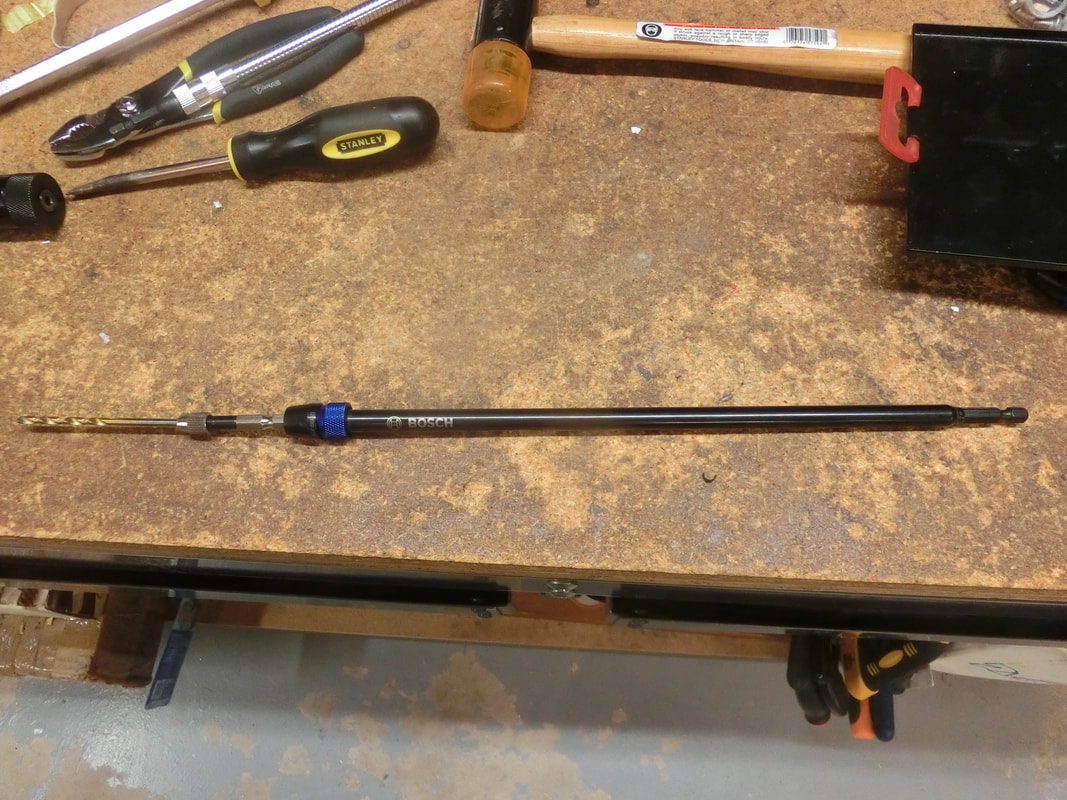
And so, I went looking for a "secret weapon" something that would allow me to push the little blocks out of their recesses without damaging anything.
After some time at the bench contemplating how to build a tool, I was tired and I returned to my desk, only to find the solution staring at me in the face:
Picture
Yup!
Those little thingies have two spring "legs" that, when removed, look like this:
Picture
AND, if you choose the right size, and if the little blocks are not damaged, they push BOTH blocks out at the same time, but we are getting ahead of ourselves.

Let's start at the beginning of the disassembly.

First of all, with a quality gun, ALWAYS look for the best fitting screw driver you have for EACH slot.
Especially because European slots are "thinner" than American slots AND are parallel; and so, sometimes you NEED to MAKE a special screwdriver for specific brands/models of guns.
IDEALLY, gunsmithing screwdrivers have hollow ground blades, meaning that the "blade" that enters the slot should have PARALLEL sides. Something that is not common in SAE screwdrivers.
Most modern airguns are adopting industrial socket standards, like Allen; even Torx are not unheard of.
BUT HW is a traditionalist, and so, slotted screws you will get and the best screwdriver needs to be found/made.
For THIS case it was not too difficult; on one hand the gun had been disassembled previously and it showed, the slots were a bit "chewed", but that gave us a chance to "chase" a bit the slots, so that they fit perfectly a SAE screwdriver:
Picture
For reference and informational purposes ONLY, this is Craftsman 9 41586 + WF  / 5/16".

IF the gun had arrived to me in pristine condition, I would have ground the tip to make the sides parallel, but in this case it made more sense to use the screwdriver's tip to "iron out" all the burrs and ensure a positive grip and drive.

At the price of these drivers, it really makes no sense not to customize the driver to the screws of a new gun.

Once the stock screws are removed, the trigger guard can be removed:
Picture
IMHO, the inletting could be a bit tighter, as the shelf that supports the guard, while enough for any reasonable torque applied to the REAR trigger guard/trigger block screw, it does seem a little "slim".
It would be fairly easy to cut a square box for the trigger block, there are tools that do that; alternatively, a much smaller tool could be used to cut a "rounded corners square hole", but either would imply changes in the tooling / CNC process and undoubtedly would add cost to the gun.
Now, no one in his/her right mind would put 45 in-lbs of torque into that rear screw, but here comes another problem: That screw is about 2mm's too long. If you tighten it enough to prevent "play" (which would bring vibrations and inconsistencies), then the trigger mechanism will not latch.
It MAY be that different stocks require different lengths and therefore ALL the guns get the same screw, That's fine as a "value engineering" but if this is your model, just take a file and remove between 1 and 2 mm's of length and be done with it.
​
So, stock removed, you have access to the mechanisms:
Picture
This gun has no "cocking shoe", which means that extra care needs to be put on the fit of the spring to the ID of the piston, and the piston to the ID of the tube., but more on that later, let's keep on disassembling "Private HW50".
​First thing is to push out the trigger block pins, yes, you need to do this first!

You start with the REAR PIN:
Picture
This allows you to hold the safety AND raise the rear end of the trigger block.
When you raise the rear end the safety will, literally, shoot out under spring pressure, but since you are holding it, you will not loose any pieces.
Now, you remove the FRONT pin:
Picture
POP Quiz!
If you only follow the pictures, you will get it wrong, hope you are reading carefully the text.


;-)

With the pins removed, you can lift the trigger guard by the REAR section and remove it from the gun.
At this point in time you still do not need a spring compressor.:
Picture
Once the trigger is removed, cock it:
Picture
It will make life so much easier upon assembly.

​And now you can use our "secret weapon" to push the locking blocks out:
Picture
Picture
If some of the blocks resist this pressure, then aid yourself with your screwdriver:
Picture
Depending on how "rough" the locking blocks are, you may opt to sand them down a bit, or not, that is up to you.
Picture
Picture
It may be that, at first, some of the little blocks will not come out at all, even under screwdriver's aid.
In that case, as long as ONE of them comes out, you can use a slimmer drift punch to drive it out:
Picture
Now we are ready to head to the spring compressor, and before anyone says anything, if you don't want to use a spring compressor, be my guest.
​Using a spring compressor is the SAFE (for both, the GUN and YOU) way.
If you do not want to be safe, or have little regard for YOUR gun, then "it's your party and you cry if you want to"; just reserve your opinions to yourself.
To do it easily and properly, you need to have some sort of "thrust bearing" between the rifle and the end of the spring compressor:
Picture
I have all sorts of bits and pieces, and so, this is just the stub of a Teflon bar. It will not mar the rifle's finish and it will allow the rear plug to rotate with little friction.
In this gun, the "thrust" of the spring against the piston is contained by that "locking lug" in the closing piece that gets rotated into place when assembling, and rotated out of "lock" to disassemble.
So a LITTLE pressure into this piece from the spring compressor (just to make sure there is no contact between the "face" of the locking lug and the mechanisms tube), and the pieces can be rotated "out of battery":
Picture
Once completely rotated "out of battery" then the closing piece can begin to slide out:
Picture
In here, it must be said that for some of the spring/guide combinations used here, which require a somewaht substantial pre-load, it was beneficial to rotate the TWO parts into each other, rifle AND closing piece.
For disassembly, this may also apply.
In any case, once the piece has begun to slide, it can then be slid out completely:
Picture
Picture
As long as you are only changing a spring, this is as far as you need to go.
At this point in time, you swap the old for the new spring, assemble in reverse order, and you're done!

However, if you want to change the piston seal, or the piston itself, you will need to further disassemble the rifle, and you start by disassembling the hinge pin in the forks, which requires to break the barrel to remove tension from the hinge/forks interfase:
Picture
Start by the "nut" on the right side of the gun, again, ensure that you select the best possible screwdriver for the job, if you do not have an ideal one, make it.
Once the "nut has been removed, you can remove the split washer underneath it :
Picture
A magnet is useful in these cases and once the split washer is removed, you can turn over the rifle, unscrew and take out the hinge-pin/screw from the left side:
Picture
Once the hinge-pin/screw has been removed, you can "wiggle out" the barrel block being careful not to loose the very thin washers that the factory put in there.
Picture
Once the barrel block and the forks have been "divorced" then the cocking lever can come out of its recess:
Picture
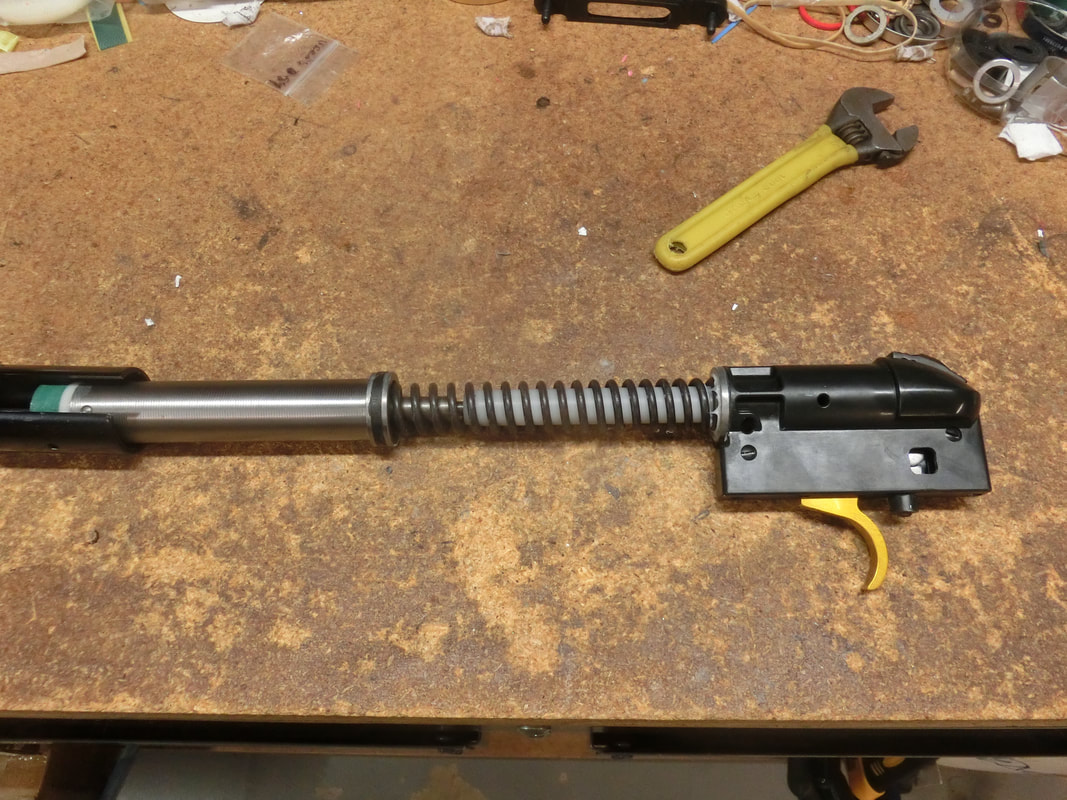
And once the cocking lever has come out, the piston can slide to the rear, while the barrel assembly can slide to the front:
Picture
With the piston out, serious measurements can take place and the planning for the modification starts taking shape:
Picture
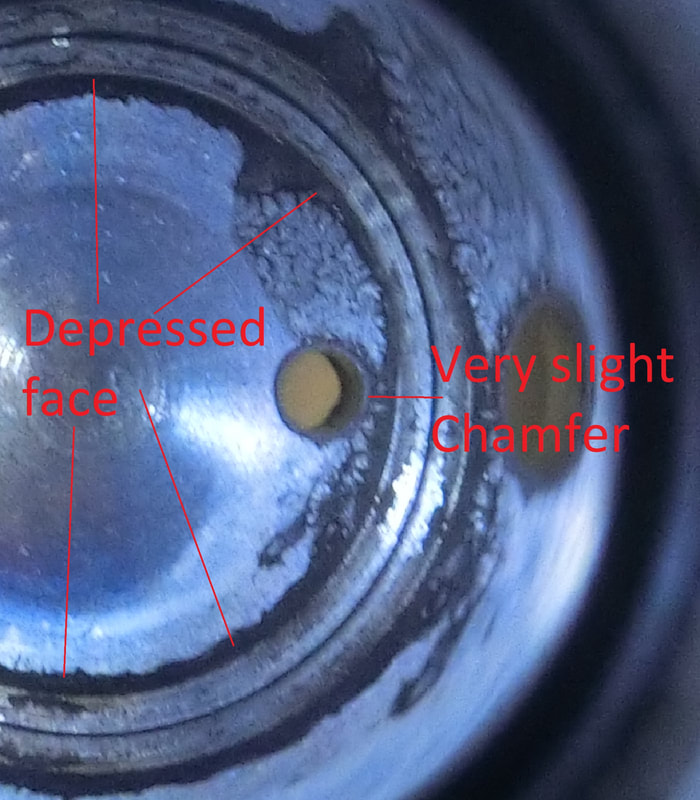
If you ever get the piston out of your HW50, do look at the inside of the compression chamber. If it looks like this:
Picture
It needs a DEEP cleaning, LOL!

Plug the TP with a small wooden dowel, spray with "Gumout"  Carb cleaner, cover the rear, stand vertically, and let it sit overnight. Then scrub with a long wooden dowel wrapped in paper/cloth and clean again.
Then clean with acetone or lacquer thinner (that also is made up of acetone), till you get something like this:
Picture

The "tune"

Using the metric punch pin as a "position holder" (3rd picture above) we can clearly see that the piston has ample room for improvement.
The Vortek seal at the top left (black one) is the same for the 95 as it is for the 50, which is peculiar, but that's what it is. The OEM seal is even taller. There's 0.4 mm's between the two, but that is what makes the rifle have (in HW's own words) "a stroke of about 71 mm's".

We also measured the TP and it is not too long.
One peculiarity is that, while not completely horizontal between compression chamber and barrel, the inclination of the transfer port is somewhat shallow:
Picture
Barely 20°, which means that the origin of the air flow from the compression chamber into the barrel's breech is at the top of the piston, not at the center.
And this may be the cause of an asymmetrical wear/galling of the piston, but we'll talk about that later.
We ran a rather long and exhaustive series of tests with "Private HW50"

We had FIVE springs, two guides, two top hats, and two sealing technologies (and three different ORing Materials).
We did NOT run all the possible 120 different tests, but we did run a fair number, enough to have a good "grasp" of what makes these little rifles "tick".

I MUST emphasize that NONE of these tests were run as "conventional" tests. ALL test were restricted to the "pop" gun (as per Cardew's definitions), with NO dieseling allowed to contribute to the energy output.

A true "Boot Camp" for the "recruit".

Just to list the springs we tested (later cut down to max allowable length for THIS piston/gun combination):
Maccari XLD 120-775/30
Vortek 118-780/30
Vortek 118-745/30
Vortek 113-780/30
Titan XS #7 127-793/30

Energies yielded as a "pop-gun" with Vortek piston seal:

-The Maccari XLD spring 120-775 yielded on a first test:
10.7 ft-lbs.- JSB/7.33
10.5 ft-lbs.- JSB/8.44

- The Vortek spring 113-780 yielded:
9.0 ft-lbs.- JSB/7.33
8.7 ft-lbs.- JSB/8.44

-The Vortek spring 118-745 yielded:
9.4 ft-lbs.- JSB/7.33
9.0 ft-lbs.- JSB/8.44

At this point in time, 
it became clear that the swept volume was not enough to reach much higher energy levels
We should also note the incredible versatility of these little rifles. With a 0.113" WD spring they can be perfectly setup for any young/small framed shooter with little upper body strength and still  yield around 8 ft-lbs
With "stronger" WD's it becomes a respectable performer that will be perfectly legal under UK law.


Since the owner wanted to compete in FT, a minimum of 11 ft-lbs was deemed logical.
Yes, it is true that many championships have been won at 10.5 ft-lbs, but these are champion shooters that have extraordinary abilities in wind-gauging and range-finding; for "mere mortals" a minimum of 11 ft-lbs is a logical starting point. 
AND, you need to remember that this is a breakbarrel rifle.
Also, a new batch of JSB/7.89 arrived and so I decided to include them.

The "Mod"

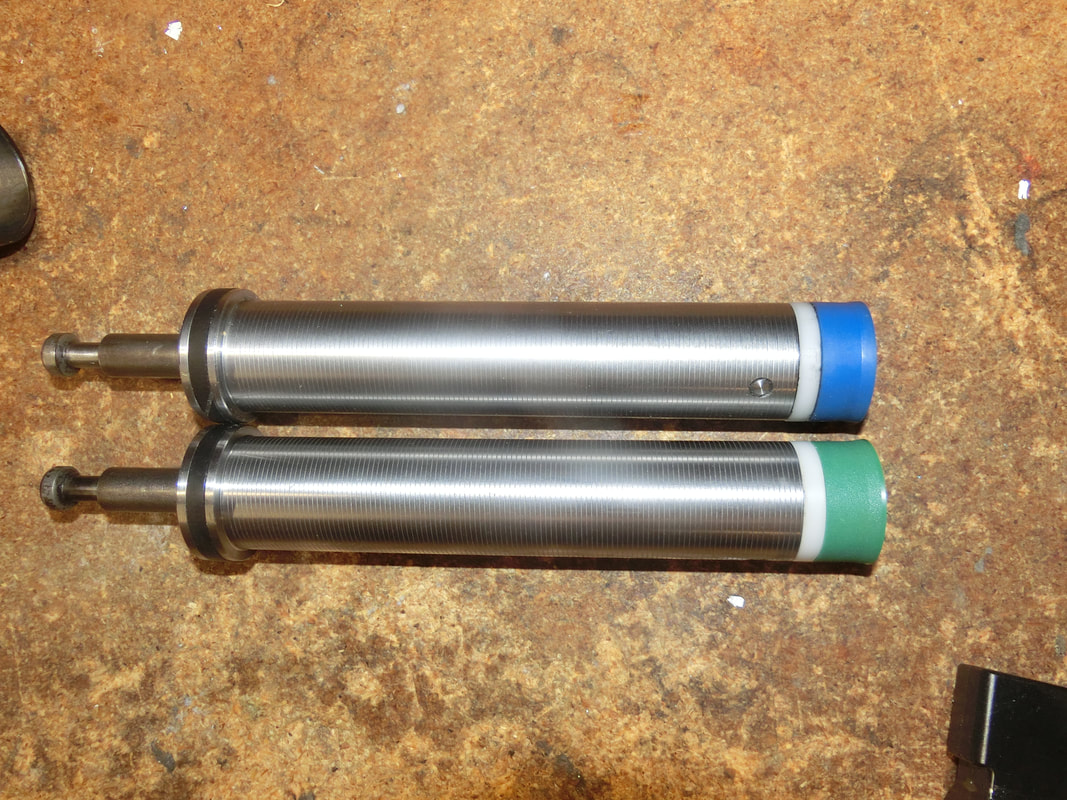
In order to achieve a larger swept volume we decided to convert the piston to an ORing head piston and allow the maximum stroke / volume possible.
Once all the "travels" had been checked, it became clear that we could go as high as a 77 mm's stroke with no secondary effects on the cocking lever, or the piston's channel.
We ordered a new piston, just in case we needed it and it is pictured below side by side with an ORing head piston. IF the modification, for any reason, is not desired, we can swap back to the OEM piston without any problems, as no other part of the gun was modified.
The difference between the total length of the OEM piston and the CCA O'Ring piston is 4.5 mm's so the rifle is not completely "maxed out". I distrust things that are maxed out. But that is just me.
In reverse of my usual tunes that involve short stroking a larger gun, this is the "long-stroking" of a smaller gun.
​
Picture
Picture
Going from the Vortek seal to the ORing head piston, the added stroke added 39 fps / 0.4 ft-lbs to the yield of the gun with the 7.9 grs pellet.

The CCA O'Ring head piston can take any ORing of the specified size. However, it has been our experience that some ORing materials are better than others for each manufacturer. Meaning that the "harmony" between one material and the compression chamber it is working in depend on a number of factors; among them: steel, uniformity and finish. Differences in output can be substantial; as an example, between the worst and the best materials, the MV's varied between 750's and 790's (5.4%) using the same pellets, spring, guide, and tophat.


Having determined which material was the best for this case, we proceeded to center ourselves in the 7.89 grs. pellet, as it seemed to draw out the best characteristics of "Private HW50": best shot cycle, and best energy.

One thing we noted was that the little rifle tended to "gall" the front lower section of the piston and the high rear section of the piston (the asymmetrical wear described above), this started happening with the Vortek seal, so we installed buttons that stopped the process.
Just to clarify, this is not the same "galling" that has been described as happening on the OUTSIDE of the action via an excessively spaced "linear bearing" in the cocking lever.

Picture
Picture
Upon re-test with the 7.9 grs. pellets, we discovered that the Maccari spring had lost 30 fps on the first 100 shots, and was now yielding 10.4 ft-lbs
We spaced it up using one and then two washers that are 2.3 mm's thick (main reason why I do not want to start maxed out), but the power output did not increase at all for the 1 washer test, remaining at 10.4 ft-lbs.
And increasing only slightly to 10.6 ft-lbs for the two washers test.
It is clear then that, for the spring in question, the compression chamber had reached the maximum output possible.
Once we re-installed the Titan XS #7 spring, output came out at 10.8 - 10.9 ft-lbs
And so, we concentrated now on learning what was the best lube for this barrel.
For that, we tested in 20 shot strings, the performance of the 7.89 grs. JSB Exact lubed with T-9 and with baked Pledge.
Here is a scatter chart of MV's. Do note that the origin of the chart is 500 fps, that origin was chosen to be able to discern the small variances in MV with a 0 fps origin, the variances are invisible.
Picture
The statistics themselves are interesting:
Picture
As you can see, the lubricant used on the pellets had somewhat of an effect on the performance.
At 788.2 average fps for the 7.89 grs. pellet yields 10.9 ft-lbs which is real close to the objective.
With an ES of 13, BUT a SsD of 3, it tells us that there were some "rogue" pellets in the tin that pushed the ES, but were unable to spoil the sample Std Dev. beyond the 3 fps. (an advantage of the 20 shot strings). Do remember that in a proper "normal" distribution, the ES is ABOUT 3 times the sd.
For statistical sakes we use the Sample standard deviation, that penalizes even further the number.

And, it could also be a question of the whole system "settling down".

We'll see what happens in the second part of this "Boot Camp" when we test for accuracy

So, keep well, shoot straight, and stay tuned!

HM
8 Comments
<<Previous
Forward>>

    Hector Medina

    2012 US National WFTF Spring Piston Champion
    2012 WFTF Spring Piston Grand Prix Winner
    2013 World's WFTF Spring Piston 7th place
    2014 Texas State WFTF Piston Champion
    2014 World's WFTF Spring Piston 5th place.
    2015 Maine State Champion WFTF Piston
    2015 Massachusetts State Champion WFTF Piston
    2015 New York State Champion WFTF Piston
    2015 US National WFTF Piston 2nd Place
    2016 Canadian WFTF Piston Champion
    2016 Pyramyd Air Cup WFTF Piston 1st Place
    2017 US Nationals Open Piston 3rd Place
    2018 WFTC's Member of Team USA Champion Springers
    2018 WFTC's 4th place Veteran Springer
    2020 Puerto Rico GP Piston First Place
    2020 NC State Championships 1st Place Piston
    2022 Maryland State Champion WFTF 
    2022 WFTC's Italy Member of TEAM USA 2nd place Springers
    2022 WFTC's Italy
    2nd Place Veteran Springers
    2023 WFTC's South Africa Member TEAM USA 1st place Springers
    2023 WFTC's South Africa
    2nd Place Veteran Springers

    Archives

    June 2024
    May 2024
    February 2024
    October 2023
    September 2023
    August 2023
    May 2023
    March 2023
    December 2022
    August 2022
    May 2022
    April 2022
    February 2022
    August 2021
    July 2021
    June 2021
    May 2021
    April 2021
    March 2021
    February 2021
    October 2020
    September 2020
    August 2020
    July 2020
    June 2020
    May 2020
    April 2020
    March 2020
    February 2020
    January 2020
    December 2019
    November 2019
    September 2019
    August 2019
    July 2019
    May 2019
    April 2019
    January 2019
    December 2018
    November 2018
    October 2018
    September 2018
    August 2018
    June 2018
    May 2018
    April 2018
    March 2018
    February 2018
    January 2018
    December 2017
    November 2017
    October 2017
    September 2017
    March 2017
    December 2016
    October 2016
    September 2016
    July 2016
    June 2016
    March 2016
    January 2016
    December 2015
    November 2015
    October 2015
    September 2015
    August 2015
    June 2015
    May 2015
    April 2015
    March 2015
    February 2015
    January 2015
    December 2014
    November 2014
    October 2014
    August 2014
    July 2014
    June 2014
    May 2014
    March 2014
    February 2014
    December 2013
    November 2013
    October 2013
    September 2013

    Categories

    All
    Events
    Gear
    Hunting
    Tests

    RSS Feed

Proudly powered by Weebly